

 English
 русский
 عربى
عربى

Fang Xuelan — Customer After-Sales Supervisor
Home / Author / Fang Xuelan — Customer After-Sales Supervisor / DK55D Heavy-Duty CNC Large-Taper Wire-Cut EDM Machine for Large and Complex Workpieces
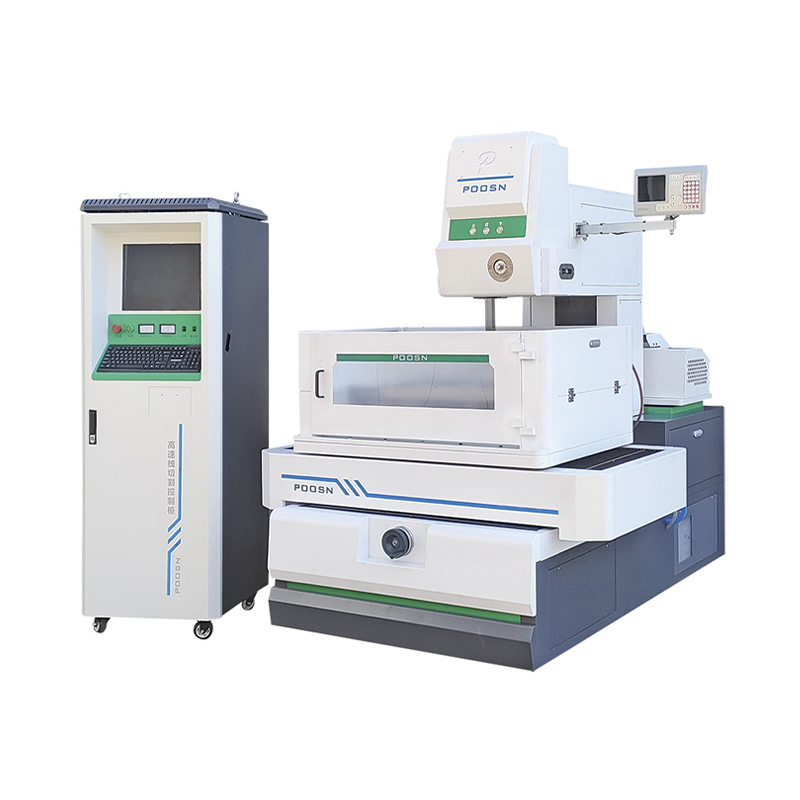
DK55D Heavy-Duty CNC Large-Taper Wire-Cut EDM Machine for Large and Complex Workpieces
2026-07-26
Large and complex workpieces often present machining challenges that cannot be solved efficiently with conventional milling, sawing, or standard two-axis wire-cut electrical discharge machining. Deep cavities, variable profiles, precision molds, heavy mechanical components, and parts requiring substantial taper angles demand a combination of large working capacity, rigid mechanical construction, accurate wire control, and coordinated multi-axis movement. The DK55D Heavy-Duty CNC Large-Taper Wire-Cut EDM Machine is designed specifically for these demanding applications.
As part of a large-taper wire-cut EDM product family, the DK55D combines a generous working envelope with a maximum table load of 600 kg, four-axis linkage, a maximum taper capability of ±30°/80 mm and ±45°/80 mm, and a stated machining accuracy of 0.08 mm. Its design is intended for large molds, heavy-duty parts, aerospace components, automotive components, precision electronic parts, and other workpieces with complex contours or inclined surfaces.
The machine is not simply a larger version of a conventional wire-cut EDM. Its principal value lies in the integration of a high-rigidity machine structure, an extended U/V tapering mechanism, controlled electrode-wire movement, a CNC system capable of coordinated X, Y, U, and V-axis machining, and a wire-feed system designed for stable long-duration operation. These features make it suitable for manufacturers that need more freedom than ordinary planar wire cutting can provide.
In addition to its technical configuration, the DK55D is supported by a manufacturer with long-term experience in electrical discharge wire cutting, in-house production capabilities, systematic accuracy inspection, and product lines covering medium-speed, high-speed, and large-taper wire-cut EDM equipment. This combination of product specialization and manufacturing experience helps customers select a machine that matches their workpiece size, taper requirements, production volume, and budget.
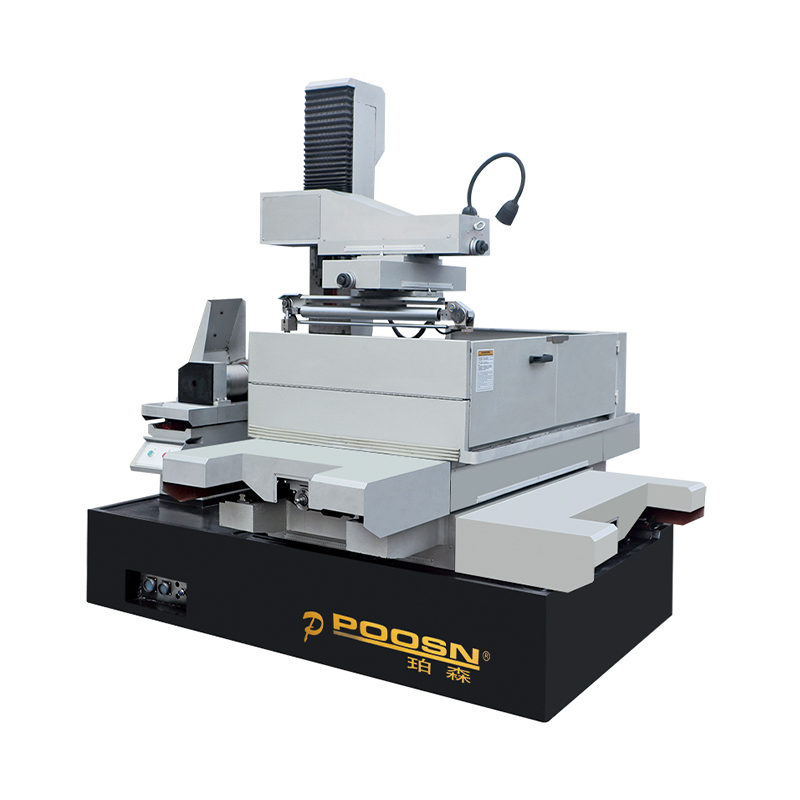
DK55D Heavy-Duty CNC Large Taper Wire Cut EDM Machine for Large Workpieces
Content
- 1 Why Large-Taper Wire-Cut EDM Is Important
- 2 DK55D Product Overview
- 3 Large Working Capacity for Heavy Components
- 4 Advanced Large-Taper Cutting Capability
- 5 Mechanical Rigidity and Accuracy Control
- 6 Wire-Feed System and Cutting Stability
- 7 Machining Efficiency and Cost Effectiveness
- 8 Comparison with Standard Wire-Cut EDM Machines
- 9 Applications Across Manufacturing Industries
- 10 Manufacturing Strengths and Quality Assurance
- 11 Customization and Configuration Flexibility
- 12 Operational Reliability and Maintenance
- 13 Model Selection Within the Large-Taper Series
- 14 Installation and Process Planning Considerations
- 15 Q&A: DK55D Large-Taper Wire-Cut EDM Machine
- 15.1 Q1: What size of workpiece can the DK55D process?
- 15.2 Q2: What is the maximum taper capability?
- 15.3 Q3: Can the DK55D machine heavy workpieces?
- 15.4 Q4: Which axes are controlled during taper machining?
- 15.5 Q5: Is the DK55D suitable for variable-taper workpieces?
- 15.6 Q6: What surface roughness can the machine achieve?
- 15.7 Q7: What control system does the machine use?
- 15.8 Q8: Can the machine be integrated into an automated production line?
- 15.9 Q9: What options are available?
- 15.10 Q10: How is long-term accuracy maintained?
- 15.11 Q11: Which industries commonly use the DK55D?
- 15.12 Q12: How should a customer decide between the DK45D, DK55D, DK63D, and DK80D?
- 16 Conclusion
- 17 References
- 18 Product: DK55D Heavy-Duty CNC Large Taper Wire Cut EDM Machine for Large Workpieces
Why Large-Taper Wire-Cut EDM Is Important
Wire-cut electrical discharge machining removes conductive material through controlled electrical discharges between a continuously moving electrode wire and the workpiece. Because the cutting tool does not make direct mechanical contact with the material, the process can machine hardened steels, hard alloys, and intricate profiles without generating the same cutting forces associated with traditional milling or turning.
Standard wire-cut EDM is highly effective for planar profiles and moderate-thickness parts. However, many modern components require a profile that changes between the upper and lower surfaces. A mold may need a draft angle, a precision component may contain a tapered slot, and an aerospace structure may include a variable cross-section. In these cases, the electrode wire must be inclined and continuously controlled while the worktable and guide system follow the programmed contour.
Large-taper machining increases the technical demands placed on the machine. The wire guides must remain stable when the wire is angled. The control system must calculate the relationship between the upper and lower profiles. The machine bed must resist the lateral forces associated with inclined cutting. The flushing system must remove eroded particles effectively, even when the cutting geometry is deep or difficult to access. The wire tension and pulse conditions must also remain stable to prevent excessive vibration, wire breakage, or inconsistent surface quality.
The DK55D addresses these requirements through four-axis linkage, a dedicated tapering device, high-precision linear guide support, a rigid machine structure, and a CNC control system. Its configuration is intended to provide a broader machining envelope than standard wire EDM while preserving the process advantages of electrical discharge machining.
DK55D Product Overview
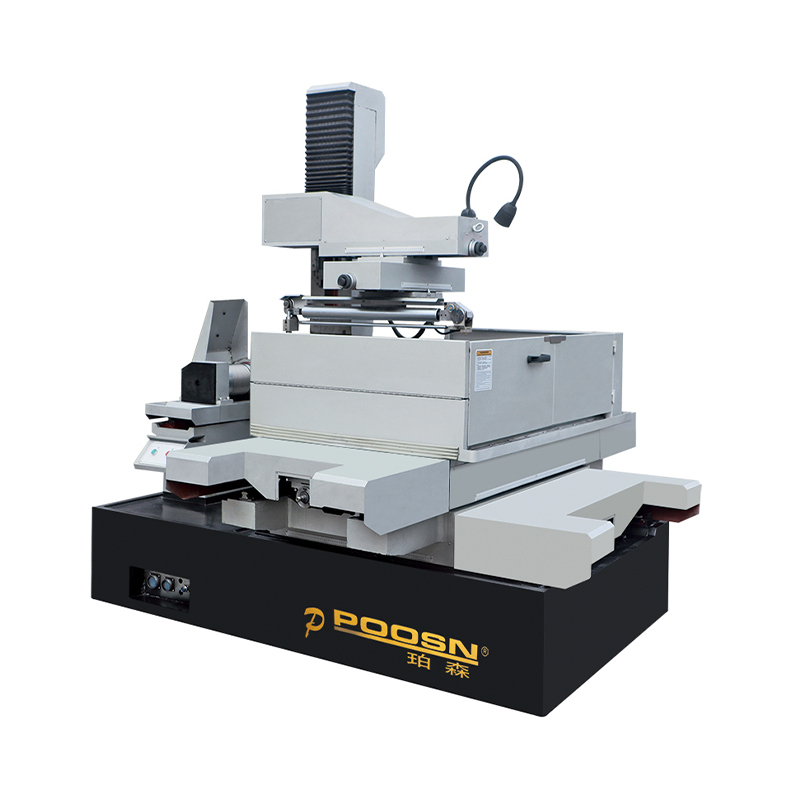
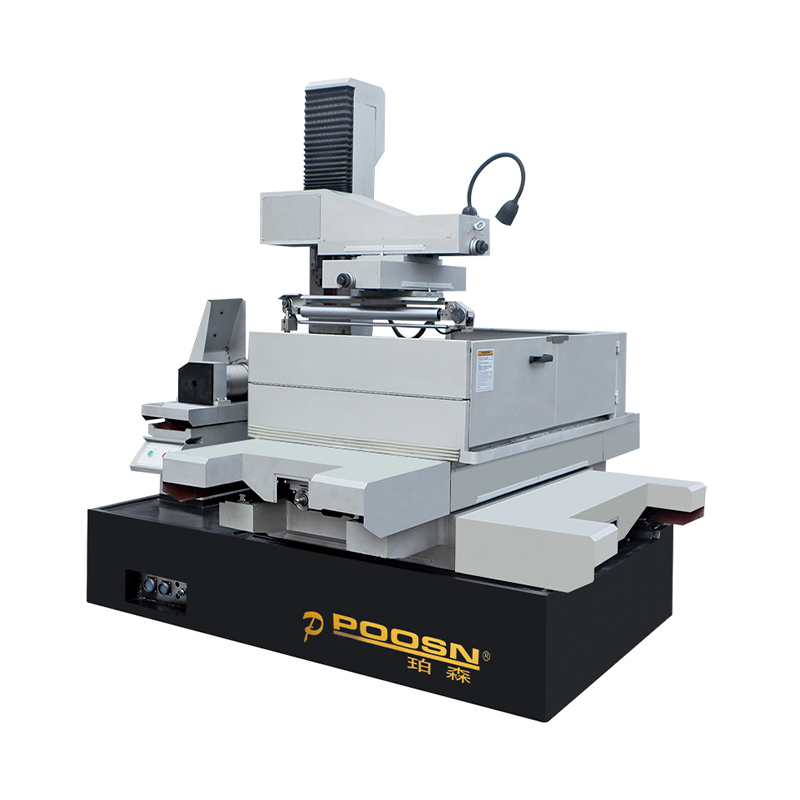
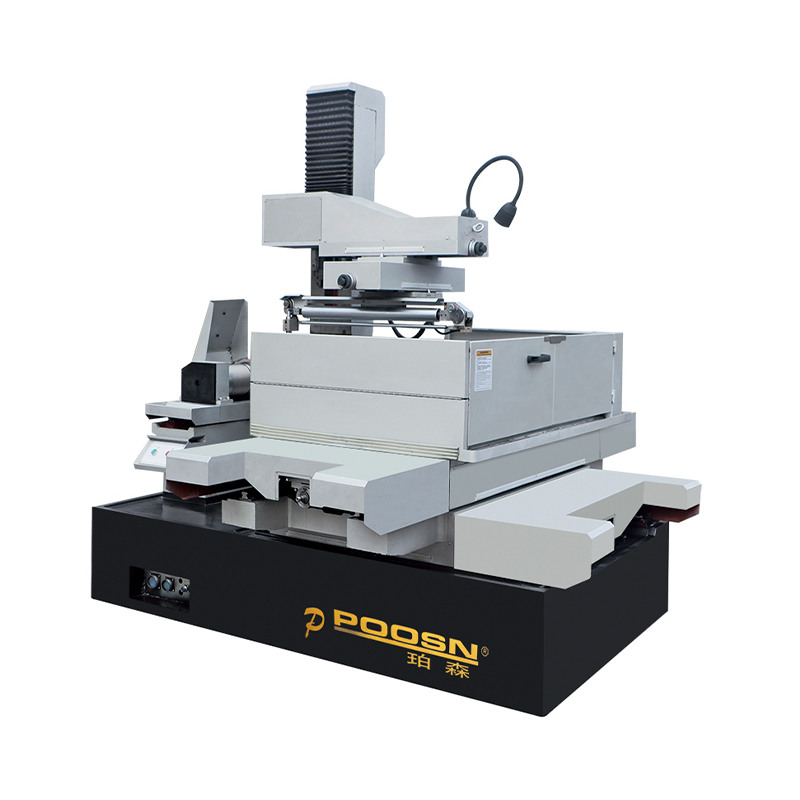
The DK55D is designed for large workpieces that require high-capacity wire cutting and significant taper movement. Its CNC worktable measures 740 × 1,160 mm, while the X- and Y-axis travel is 550 × 800 mm. The processing slot measures 770 × 1,180 mm, and the maximum cutting thickness is 600 mm. A maximum worktable load of 600 kg allows the machine to support substantial molds, plates, dies, and heavy mechanical components.
The tapering system supports a maximum cutting taper of ±30°/80 mm and ±45°/80 mm. This capability allows the DK55D to produce inclined profiles and more complicated spatial contours that are outside the practical range of many conventional wire-cut EDM machines. The machine uses X, Y, U, and V four-axis linkage, enabling the worktable movement and tapering motion to be coordinated during machining.
The electrode wire specification is Φ0.18 mm with a wire guider. The wire-feed speed can be adjusted from 1 to 11 m/s through frequency control, and the maximum wire storage length is approximately 350 m. The maximum cutting efficiency is listed at 10,000 to 16,000 mm²/h, while the optimal surface roughness is specified as Ra ≤ 2.5 μm under appropriate processing conditions.
The standard configuration includes high-precision linear rail support and an eco-friendly waterproof cover. A high-pressure water tank and linear scale are available as optional equipment. The worktable can use standard XY stepper drives, while optional XY AC servo drives are available for applications that require a different drive configuration. The U and V axes use three-phase stepper drives, and the Z-axis lift is powered by an AC 220 V electric motor.
| Specification | DK55D Configuration |
| Worktable size | 740 × 1,160 mm |
| X/Y travel | 550 × 800 mm |
| Processing slot size | 770 × 1,180 mm |
| Maximum cutting thickness | 600 mm |
| Maximum worktable load | 600 kg |
| Maximum cutting taper | ±30°/80 mm; ±45°/80 mm |
| Electrode wire diameter | Φ0.18 mm with wire guider |
| Wire-feed speed | 1–11 m/s, frequency controlled |
| Maximum wire storage length | Approximately 350 m |
| Maximum cutting efficiency | 10,000–16,000 mm²/h |
| Optimal surface roughness | Ra ≤ 2.5 μm |
| Controlled axes | X, Y, U, and V four-axis linkage |
| Programming system | X8/AUTOCUT control system |
| Maximum processing current | 6 A |
| Electrical capacity | 2.5 KVA |
| Machine weight | Approximately 2,000 kg |
Large Working Capacity for Heavy Components
One of the most important advantages of the DK55D is its ability to combine large workpiece capacity with taper-cutting functionality. A machine may offer advanced taper control but still be unsuitable for large molds if its table, travel, or loading capacity is limited. Conversely, a large machine without a suitable taper system may not be able to process complex inclined profiles. The DK55D is configured to address both requirements.
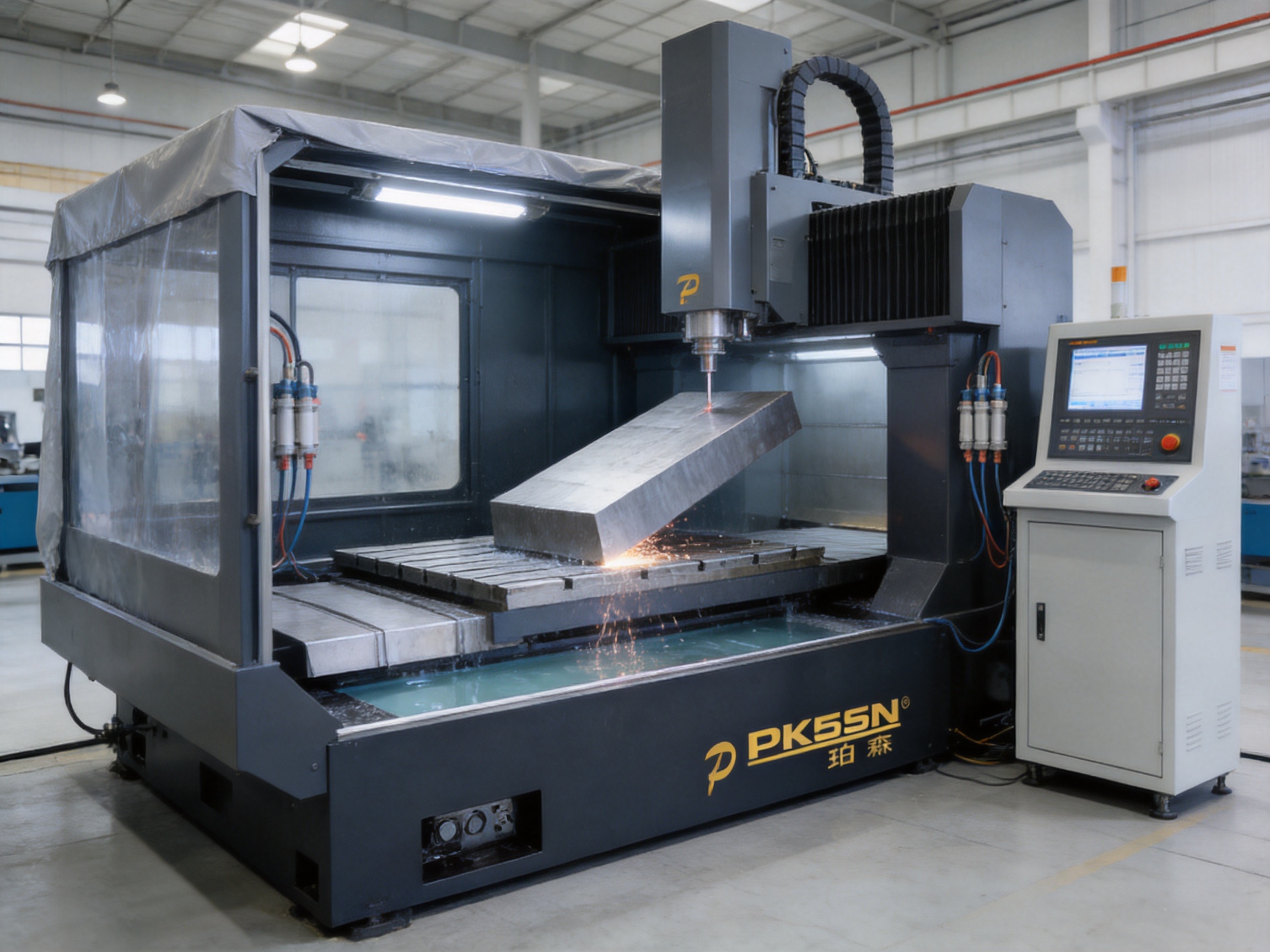
The 550 mm X-axis travel and 800 mm Y-axis travel provide a substantial machining area for large components. The 600 mm maximum cutting thickness gives users greater flexibility when processing thick plates, large mold inserts, heavy-duty dies, and structural parts. The 600 kg maximum table load also supports workpieces that would be difficult to mount safely on a smaller wire-cut machine.
Large capacity does not only refer to the external dimensions of the part. It also involves the machine’s ability to maintain stable movement under load. Heavy workpieces can affect table motion, guide performance, alignment, and vibration. The DK55D uses a heavy machine structure and high-precision linear guide support to maintain controlled movement during machining. Proper installation, leveling, workpiece clamping, and maintenance remain essential, but the machine’s basic construction is intended for demanding loaded conditions.
The worktable and cutting depth can also be customized according to customer requirements. This adaptability is valuable for manufacturers whose workpieces do not fit standard production dimensions. Customization may help users match the machine to specialized molds, large structural components, or production processes involving unusual workpiece dimensions.
Advanced Large-Taper Cutting Capability
The DK55D’s most distinctive feature is its large taper range. The machine supports a maximum cutting angle of ±30°/80 mm and ±45°/80 mm. In practical terms, this means that the wire can be controlled at a substantial angle over an 80 mm reference height, allowing the machine to produce inclined, tapered, and spatially changing profiles.
Large taper cutting is useful for die-casting molds, stamping tools, variable-diameter components, tapered slots, special gears, splines, aerospace structures, and parts with different upper and lower contours. Instead of relying on multiple setups or secondary machining operations, manufacturers can complete more of the geometry directly on the wire EDM machine.
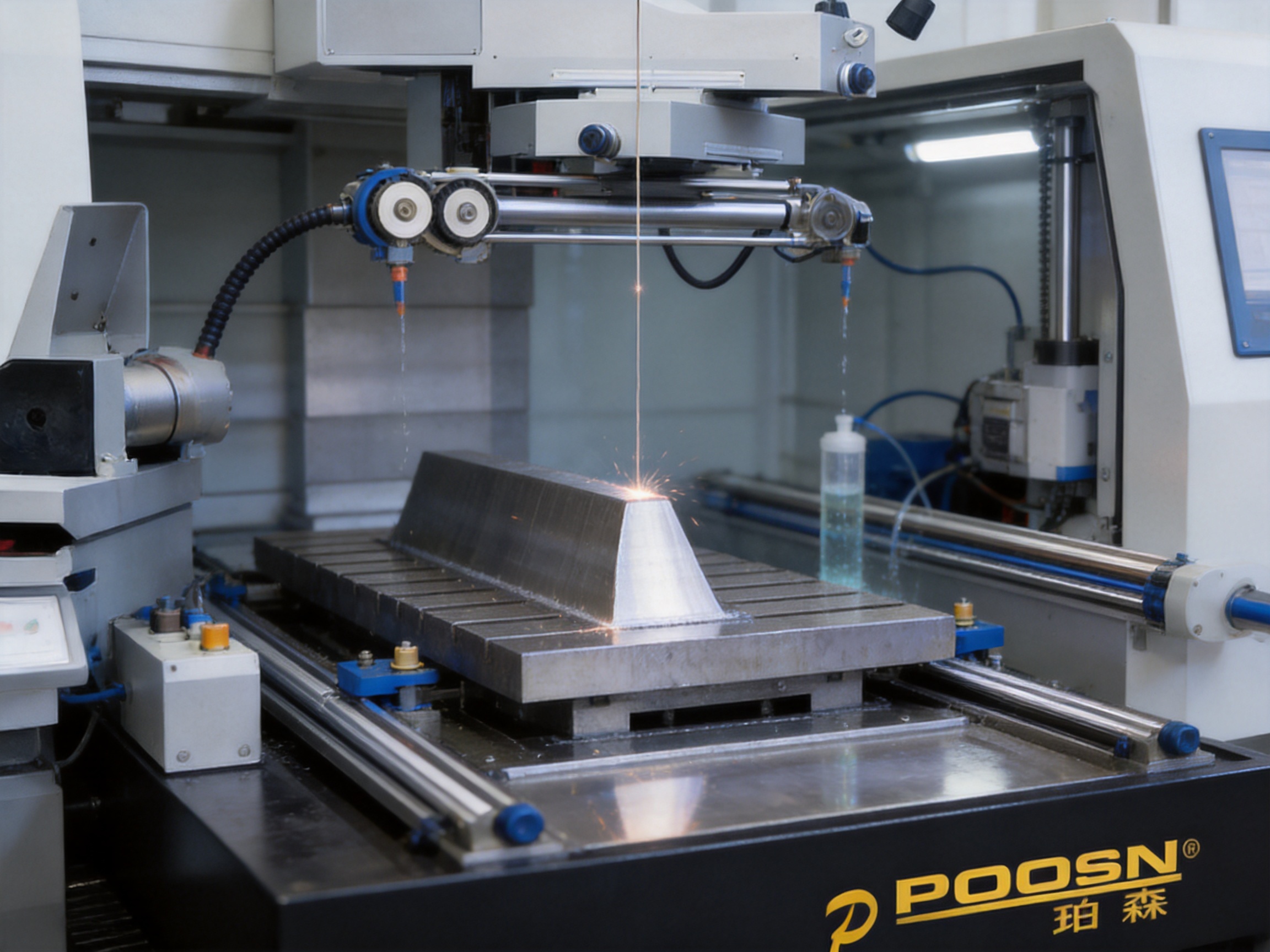
The tapering function is based on the coordinated movement of the U and V axes with the primary X and Y axes. The X and Y axes define the principal cutting path, while the U and V axes control the relationship between the upper and lower wire-guide positions. The CNC system must calculate these movements continuously so that the electrode wire follows the required three-dimensional path.
This approach provides greater flexibility than a machine designed primarily for two-dimensional profiles. It also supports variable-taper machining, where the angle changes along the cutting path or where the upper and lower profiles differ. The ability to calculate and execute such paths can reduce the need for manual correction and improve repeatability between workpieces.
Four-Axis Linkage and Spatial Compensation
The DK55D uses X, Y, U, and V four-axis linkage. Coordinated movement is critical when the workpiece requires more than a constant taper. If the wire angle changes without accurate compensation, the resulting part may suffer from dimensional errors, uneven draft angles, or mismatches between the upper and lower profiles.
The control system is designed to coordinate the four axes and apply the necessary spatial compensation. This allows the wire to maintain the intended relationship with the programmed geometry while the table moves through the contour. The result is a more practical solution for parts requiring three-dimensional profiles, angled cavities, and variable-taper transitions.
Flexible Guide and Tapering Mechanism
Large-angle machining places greater demands on the wire guide mechanism. The upper and lower guides must allow the electrode wire to incline while maintaining positional stability. A flexible high-precision tilting or swiveling arrangement helps reduce the risk of wire deviation, excessive vibration, and inconsistent discharge conditions.
Stable wire guidance is particularly important when machining thick sections. As cutting thickness increases, the relationship between the wire, dielectric fluid, and workpiece becomes more sensitive to vibration and flushing conditions. A properly controlled guide system helps maintain the intended cutting path throughout the workpiece depth.
Mechanical Rigidity and Accuracy Control
A heavy-duty wire EDM machine must provide more than a large table. The machine bed, worktable, guide rails, drive systems, tapering device, and electrical cabinet must function as an integrated system. Any weakness in one part of this chain can affect dimensional consistency and surface quality.
The DK55D uses a high-rigidity machine structure designed to resist deformation during large-workpiece and large-taper machining. The machine bed is based on a strong cast-iron structure that is subjected to aging treatment. Aging treatment helps reduce internal stress in the casting and supports long-term geometric stability.
Rigidity is especially important during large-angle cutting because the electrode wire is no longer aligned vertically through the workpiece. Inclination introduces lateral force components and changes the behavior of the wire within the cutting gap. If the machine structure or guide system moves excessively, the resulting contour may deviate from the programmed path.
High-precision linear rails provide a stable foundation for table movement. Compared with less precise or less rigid guide arrangements, precision linear rails can improve positioning repeatability, reduce friction variation, and support smoother movement. Optional linear scales are available for applications in which direct position feedback is required.
The stated machining accuracy of 0.08 mm is intended to meet a range of precision engineering requirements. Actual results depend on workpiece material, thickness, wire condition, flushing, programming, environmental temperature, machine leveling, maintenance, and cutting parameters. Nevertheless, the combination of rigid construction, controlled movement, and systematic inspection provides a foundation for repeatable production.
Wire-Feed System and Cutting Stability
The electrode wire is a central element in the EDM process. It must travel continuously through the workpiece while maintaining suitable tension and stable electrical contact conditions. Irregular wire movement can lead to wire breakage, poor surface finish, dimensional deviations, or unstable machining.
The DK55D uses a Φ0.18 mm electrode wire with a wire guider. Its wire-feed speed ranges from 1 to 11 m/s and is controlled through frequency adjustment. This range gives the operator flexibility to select suitable wire movement conditions for different materials, thicknesses, cutting speeds, and surface-finish requirements.
The approximately 350 m wire storage length supports extended machining cycles. Longer wire storage reduces the frequency of manual replenishment and can help maintain production continuity. It is particularly useful when machining large workpieces or when the machine is used for unattended or semi-automated operation.
The wire-feed arrangement is designed to maintain steady wire movement during straight and inclined cutting. Large taper angles can increase the possibility of wire vibration, especially if the cutting speed, flushing pressure, or electrical conditions are not properly matched. A stable wire-feed system, combined with an appropriate guide mechanism, helps reduce these risks.
Operators should select wire type, wire tension, feed speed, pulse parameters, and flushing conditions according to the workpiece material and geometry. The machine provides the mechanical and control platform, while process optimization is required to achieve the best balance of cutting efficiency, dimensional accuracy, and surface roughness.
Machining Efficiency and Cost Effectiveness
Production efficiency is influenced by cutting speed, setup time, rework, material waste, maintenance, energy use, and the number of secondary operations required. The DK55D is designed to improve efficiency by combining large capacity with multi-axis taper machining in one platform.
The stated maximum cutting efficiency is 10,000 to 16,000 mm²/h. The actual cutting rate varies according to material type, thickness, workpiece geometry, wire condition, electrical parameters, flushing performance, and desired surface quality. Rough cutting may prioritize material removal, while finishing passes may prioritize accuracy and surface condition.
Large-taper machining can reduce production steps when a part would otherwise require an additional milling, grinding, or manual fitting operation. Completing an inclined profile directly on the wire EDM machine can reduce the number of setups and the risk of transferring errors between machines. It may also reduce the need for specialized fixtures.
The optimized wire-feed and cutting-control systems are intended to limit unnecessary power consumption and material waste. The machine’s electrical capacity is listed as 2.5 KVA, and the maximum processing current is 6 A. Efficient use of discharge energy can help control operating costs while maintaining suitable removal performance.
Cost effectiveness must also be considered over the service life of the equipment. A rigid machine with accessible components, stable guides, reliable control, and a structured maintenance program can help reduce downtime. Regular inspection of wire guides, electrical contacts, pumps, filters, seals, drive components, and coolant or dielectric systems is essential for preserving performance.
Comparison with Standard Wire-Cut EDM Machines
Conventional wire-cut EDM machines remain valuable for many applications, particularly when parts are relatively thin, profiles are primarily two-dimensional, and taper requirements are limited. However, their capabilities may become restrictive when a part requires a large angle, thick-section machining, or a changing spatial profile.
The DK55D has several advantages in these situations. Its worktable and cutting envelope are larger than those of many general-purpose machines. Its maximum table load is suitable for heavy workpieces. Its U/V tapering system provides greater angular freedom. Its four-axis linkage allows coordinated spatial machining instead of simple planar cutting. Its rigid structure is intended to support stability under heavy and inclined cutting conditions.
| Comparison Area | Standard Wire-Cut EDM | DK55D Large-Taper Wire-Cut EDM |
| Primary machining focus | Planar profiles and moderate taper | Large profiles, inclined surfaces, and complex taper machining |
| Axis configuration | Often focused on X and Y movement | X, Y, U, and V four-axis linkage |
| Workpiece capacity | Generally suited to small or medium parts | 550 × 800 mm travel, 600 mm thickness, and 600 kg load |
| Taper capability | Limited or intended for smaller angles | Up to ±30°/80 mm and ±45°/80 mm |
| Guide mechanism | Fixed or limited-range movement | Designed for flexible large-angle wire guidance |
| Complex contour capability | Mostly two-dimensional profiles | Three-dimensional contours and variable-taper geometries |
| Application range | Conventional dies and simple components | Large molds, heavy parts, aerospace components, gears, and splines |
| Customization potential | Often based on fixed standard configurations | Worktable and cutting-depth customization available |
The DK55D is not intended to replace every smaller wire EDM machine. A smaller model may be more economical for compact parts, limited cutting thickness, or routine production. The principal advantage of the DK55D is its ability to address workpieces that require both substantial physical capacity and advanced taper control.
Applications Across Manufacturing Industries
Large Mold Manufacturing
Large molds frequently include deep cavities, draft angles, narrow slots, complex inserts, and profiles that vary between the top and bottom surfaces. The DK55D can machine these features with controlled wire movement and large taper capability.
For die-casting and stamping molds, taper cutting can help produce draft features and inclined cavity walls. The ability to perform these cuts directly on the EDM machine may reduce secondary operations and simplify the production route. The machine’s 600 mm maximum cutting thickness and 600 kg table load also make it suitable for substantial mold components.
Heavy Machinery Components
Heavy machinery parts often combine large dimensions with demanding dimensional requirements. Examples include plates, structural components, guide elements, special brackets, and large dies. These parts may be difficult to fixture on a smaller machine or may exceed the load capacity of a general-purpose model.
The DK55D provides a larger table and a heavy-duty structure for such work. Its wire-cut process can machine hardened materials without applying conventional cutting forces, which is helpful for components that have already undergone heat treatment.
Aerospace and Defense Components
Aerospace and defense components may feature specialized channels, variable sections, tapered openings, lightweight structures, and high-performance alloys. These geometries can require accurate control of both the main profile and the relationship between upper and lower surfaces.
The DK55D’s four-axis linkage and large-taper capacity offer a practical approach for machining such features. The non-contact nature of EDM is also beneficial when machining hard conductive materials or intricate profiles that may be difficult to produce with conventional tooling.
Automotive Components
Automotive production uses molds, dies, precision fixtures, gears, splines, and special components that may require repeatable profiles and efficient production. The DK55D can support larger automotive dies and complex parts that include inclined or variable-taper features.
Its production efficiency, wire storage capacity, and optional automation integration can help manufacturers improve throughput. The machine may be used for prototype production, mold repair, low-volume specialized components, or larger-scale manufacturing depending on the production plan.
Electronic and Precision Components
Electronic products and precision assemblies often require small slots, thin sections, precise profiles, and stable repeatability. Although many electronic parts can be processed on smaller machines, larger fixtures, specialized tooling plates, or complex taper requirements may justify the DK55D’s capacity.
Where surface quality is important, the machine can be operated with finishing passes and optimized electrical parameters to achieve the specified surface roughness target. The final result depends on the material and process conditions, but the machine provides the control platform required for precision work.
Gears, Splines, and Variable-Profile Parts
Precision gears and splines may require specialized profiles, controlled clearances, or tapered geometries. Wire EDM can produce intricate tooth forms and slots without imposing significant mechanical cutting forces. When the upper and lower profiles are different, the DK55D’s U/V control can support the required spatial compensation.
Manufacturing Strengths and Quality Assurance
The performance of a wire EDM machine depends not only on its published specifications but also on the quality of its production process. A machine with a strong design can fail to deliver consistent results if castings, guide surfaces, electrical systems, or assembly procedures are not controlled carefully.
The manufacturer of the DK55D has specialized in electrical discharge wire cutting since 1999. Its product portfolio includes medium-speed wire-cutting EDM machines, high-speed wire-cutting EDM machines, and large-taper wire-cutting EDM machines. This product focus provides experience across different levels of machine capacity, cutting speed, automation, and taper capability.
The company operates with advanced processing equipment, comprehensive testing methods, and product designs developed for industrial use. Components are subjected to machining and finishing processes intended to provide accurate mating surfaces and stable assembly. Precision grinding and finishing are important for guide surfaces, worktable components, and other parts that affect movement accuracy.
Positioning accuracy testing is performed before shipment. The inspection process includes static geometric checks such as worktable flatness and axis perpendicularity, as well as dynamic positioning checks. Full-stroke bidirectional testing can identify errors associated with movement direction, backlash, positioning repeatability, and axis travel.
High-precision instruments, including laser interferometer systems where applicable, can be used to verify axis accuracy. These tests provide a more objective assessment than visual inspection alone. They also help establish a quality record before the machine leaves the factory.
The machine is manufactured according to applicable national standards, including the GB/T 7926-2015 accuracy standard listed for the product family. Standards-based testing gives customers a reference framework for machine acceptance and performance verification.
Quality control also involves electrical integration. The CNC system, control cabinet, drive units, wire-feed system, pumping equipment, sensors, and safety-related components must operate as a coordinated system. Proper wiring, cabinet assembly, parameter configuration, and functional testing are essential for reliable operation.
Customization and Configuration Flexibility
Different manufacturers have different requirements for table size, cutting depth, workpiece loading, drive systems, automation, and control. The DK55D can be adapted in selected areas to match customer production conditions.
Worktables and cutting depths can be customized according to specific requirements. This is particularly useful for customers processing unusual workpiece dimensions or parts that fall between standard machine categories. Customization should be evaluated together with structural rigidity, travel range, flushing requirements, and installation space.
The standard XY drive configuration uses stepper drives. AC servo drives are available as an option for the XY axes. The selection depends on the required positioning behavior, production volume, control preferences, and customer process standards.
A high-pressure water tank is available as an optional configuration. Enhanced flushing can be useful for deep, thick, or geometrically difficult cuts where the removal of eroded particles is more challenging. Linear scales are also available for applications requiring direct position feedback.
The machine supports automated operation and can be integrated with other equipment or production lines. Automation can reduce manual intervention, improve repeatability, and support longer unattended machining cycles. The specific automation solution should be designed around loading, unloading, workpiece identification, process monitoring, and safety requirements.
Operational Reliability and Maintenance
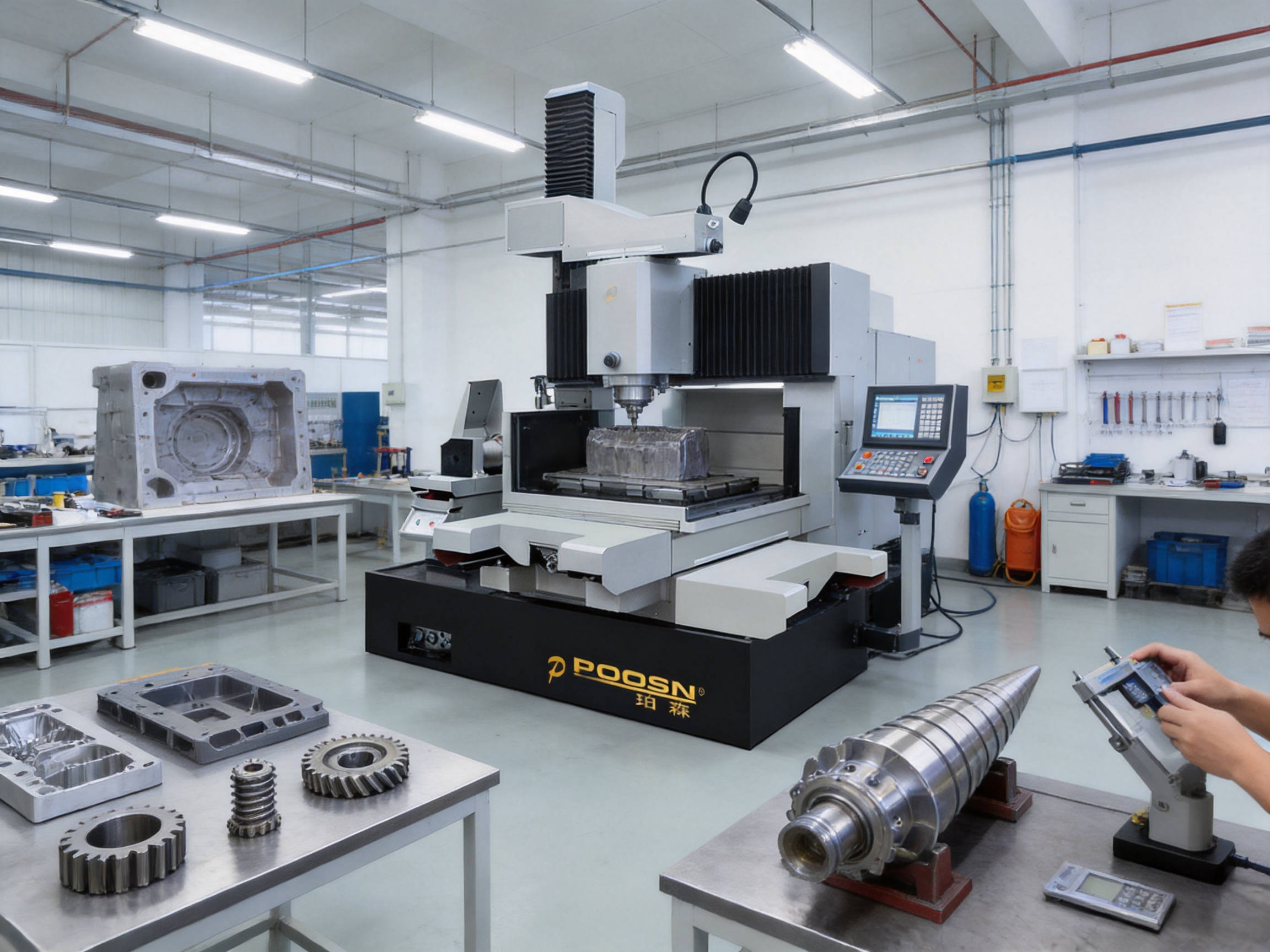
Long-term machining stability requires a combination of machine quality, correct installation, disciplined operation, and regular maintenance. The DK55D is designed with high-precision linear guides, a rigid machine body, and a protected working area to support sustained operation.
The eco-friendly waterproof cover helps protect machine components from the working fluid, debris, and the general conditions created during EDM cutting. Keeping the cover, work area, guide assemblies, and tank system clean is important for stable operation.
Wire guides and electrical contacts are consumable or wear-sensitive components. Their condition affects wire alignment, electrical transfer, cutting stability, and surface quality. Operators should inspect them regularly and replace them according to actual wear and manufacturer recommendations.
Filters and pumps should be checked to ensure adequate circulation and flushing. Contaminated or poorly maintained dielectric fluid can reduce machining stability and affect the discharge gap. The tank, hoses, nozzles, and filtration system should be maintained as part of the normal service schedule.
Linear rails, drive systems, wire drums, and tapering mechanisms require inspection for contamination, abnormal noise, looseness, or movement resistance. Any unusual behavior should be addressed before it develops into a larger accuracy or downtime problem.
The manufacturer provides professional technical support and maintenance assistance to help customers preserve machine performance. Rapid response is particularly valuable for production users whose processes depend on continuous operation and stable dimensional results.
Model Selection Within the Large-Taper Series
The DK55D is one model within a broader large-taper product family. Selecting the correct model requires consideration of workpiece dimensions, maximum thickness, load, taper angle, production volume, installation space, and future expansion plans.
The DK45D is suitable for medium-sized components and precision molds. It provides a 450 × 650 mm X/Y travel, a maximum cutting thickness of 450 mm, and a maximum worktable load of 400 kg. It may be appropriate when the workpieces are smaller but still require large-taper capability.
The DK55D is intended for larger workpieces and complex-shaped components. Its 550 × 800 mm travel, 600 mm maximum cutting thickness, 600 kg load capacity, and large taper range provide a balanced solution for many heavy-duty applications.
The DK63D is designed for extra-large workpieces and heavy-duty components. Its X/Y travel is 630 × 1,000 mm, with a maximum table load of 800 kg. It is particularly suitable for larger aerospace components and molds.
The DK80D is the largest model listed in the series. It offers 800 × 1,200 mm X/Y travel, an 800 mm maximum cutting thickness, and a 1,000 kg maximum table load. It is intended for very large molds, oversized components, and high-difficulty production tasks. Customizable options are available for the DK80D and larger machines according to project requirements.
Installation and Process Planning Considerations
Before purchasing or installing the DK55D, customers should confirm the complete workpiece envelope rather than relying only on nominal dimensions. The workpiece must fit within the processing slot after fixtures, clamps, wire-guide movement, and flushing requirements are considered.
Floor loading and access routes should also be evaluated. The DK55D weighs approximately 2,000 kg and measures about 2,210 × 2,030 × 2,335 mm. The installation site must provide sufficient structural support, working clearance, electrical supply, drainage, fluid handling, and maintenance access.
Workpiece clamping should be rigid and repeatable. Because large-taper cutting can produce complex spatial relationships, fixture errors may affect the final geometry. The workpiece should be aligned carefully, and the upper and lower reference positions should be verified before cutting.
Programming should account for the required upper and lower profiles, taper angle, cutting thickness, offset, wire diameter, flushing direction, and finishing strategy. For variable-taper parts, the programmed geometry should be checked carefully before machining. Simulation or verification procedures can help identify potential overcutting, undercutting, or interference.
Environmental stability also matters in precision EDM. Temperature changes can affect machine geometry, workpiece dimensions, dielectric conditions, and measurement results. A stable workshop environment, proper machine leveling, and regular geometric verification help improve repeatability.
Q&A: DK55D Large-Taper Wire-Cut EDM Machine
Q1: What size of workpiece can the DK55D process?
The DK55D has an X-axis travel of 550 mm and a Y-axis travel of 800 mm. Its processing slot is approximately 770 × 1,180 mm, with a maximum cutting thickness of 600 mm. The practical workpiece size depends on the part geometry, fixture arrangement, taper movement, and required clearance.
Q2: What is the maximum taper capability?
The listed maximum cutting taper is ±30°/80 mm and ±45°/80 mm. This capability makes the machine suitable for large-angle inclined profiles, draft features, tapered slots, and components whose upper and lower contours are different.
Q3: Can the DK55D machine heavy workpieces?
Yes. The maximum worktable load is 600 kg. Heavy workpieces must still be mounted with suitable support and clamping methods, and the total load should be distributed safely across the table.
Q4: Which axes are controlled during taper machining?
The machine uses X, Y, U, and V four-axis linkage. X and Y control the main worktable movement, while U and V control the relative position of the upper and lower wire guides for taper and spatial compensation.
Q5: Is the DK55D suitable for variable-taper workpieces?
Yes. Its four-axis linkage and CNC tapering system are designed to support geometries in which the taper changes along the cutting path or the upper and lower profiles are not identical. Correct programming and process verification are necessary for reliable results.
Q6: What surface roughness can the machine achieve?
The optimal surface roughness is listed as Ra ≤ 2.5 μm. Actual surface quality depends on the material, thickness, wire condition, pulse parameters, flushing, cutting strategy, and whether finishing passes are used.
Q7: What control system does the machine use?
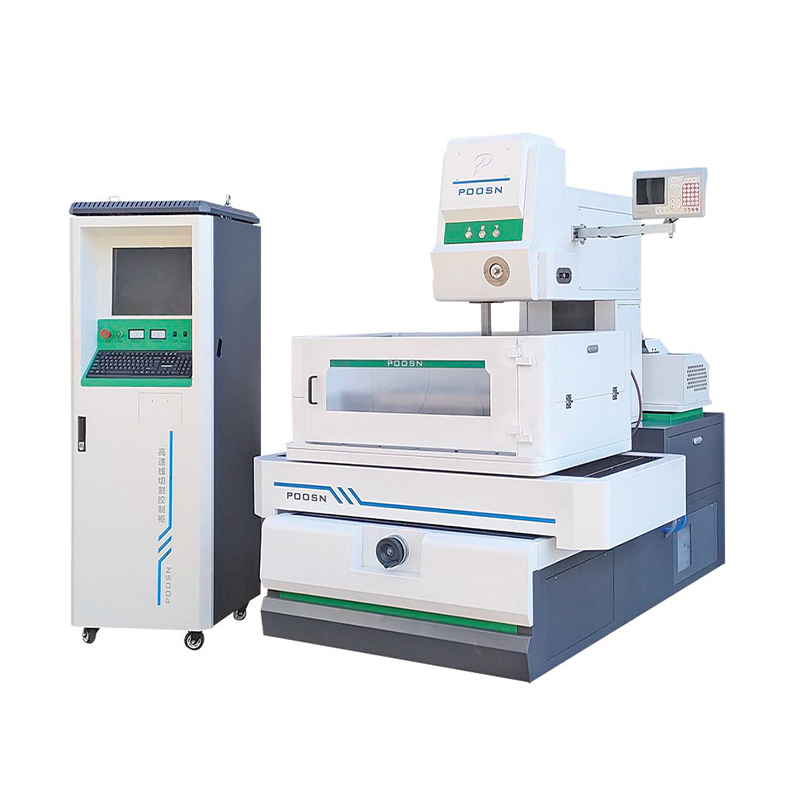
The standard programming system is the X8/AUTOCUT control system. The control cabinet is listed as the ZHZK-03 standard configuration, with the ZHZ-09G available as an option.
Q8: Can the machine be integrated into an automated production line?
Yes. The DK55D supports automated operation and can be integrated with other equipment or production-line systems. The exact solution depends on loading and unloading requirements, process monitoring, workpiece identification, safety systems, and factory layout.
Q9: What options are available?
Optional configurations include a high-pressure water tank, linear scales, and AC servo drives for the XY axes. Worktable and cutting-depth customization can also be discussed according to the customer’s workpiece and production requirements.
Q10: How is long-term accuracy maintained?
Long-term accuracy depends on the rigid machine structure, precision linear guides, correct installation, regular maintenance, stable environmental conditions, and periodic geometric inspection. Wire guides, contacts, pumps, filters, drives, and tapering components should be maintained according to operating conditions.
Q11: Which industries commonly use the DK55D?
Typical applications include large mold manufacturing, heavy machinery parts, aerospace and defense components, automotive dies, precision electronic components, gears, splines, variable-profile parts, and other conductive workpieces requiring complex taper cutting.
Q12: How should a customer decide between the DK45D, DK55D, DK63D, and DK80D?
The decision should be based on maximum workpiece size, thickness, weight, taper requirements, production volume, available floor space, and future capacity needs. The DK55D is a balanced choice for large workpieces and complex components when the DK45D is too small but the capacity of the DK63D or DK80D is not required.
Conclusion
The DK55D Heavy-Duty CNC Large-Taper Wire-Cut EDM Machine is designed for manufacturers that need more than conventional planar wire cutting. Its combination of large working capacity, 600 kg loading capability, 600 mm maximum cutting thickness, four-axis linkage, and ±30°/80 mm and ±45°/80 mm taper capability gives it a strong position in the processing of large and complex conductive workpieces.
Its advantages are supported by a rigid machine structure, high-precision linear guide support, controlled wire feeding, approximately 350 m wire storage capacity, a maximum cutting efficiency of 10,000 to 16,000 mm²/h, and an optimal surface roughness of Ra ≤ 2.5 μm. Optional linear scales, high-pressure flushing, AC servo drives, and customization services allow the machine to be adapted to different production environments.
Compared with standard wire-cut EDM machines, the DK55D offers greater freedom for three-dimensional contours, large taper angles, thick sections, and heavy workpieces. It can reduce secondary operations, simplify complex setups, and support more efficient production of molds, aerospace components, machinery parts, automotive dies, gears, splines, and specialized precision components.
The manufacturer’s long-term focus on wire-cut EDM, advanced processing equipment, systematic accuracy inspection, national-standard manufacturing, and technical support further strengthens the machine’s value. For companies seeking a reliable large-taper machining platform with room for customization and future production development, the DK55D provides a practical combination of capacity, precision, flexibility, and industrial durability.
References
1. Product technical specifications for the DK-D Large Cutting Taper WEDM series.
2. GB/T 7926-2015, Accuracy requirements and inspection principles for wire-cut electrical discharge machine tools.
3. General principles of wire-cut electrical discharge machining, including electrode-wire control, discharge-gap management, flushing, and surface-finish optimization.
4. Manufacturer-provided information concerning DK55D machine configuration, application fields, customization services, and maintenance support.
5. Technical documentation concerning CNC interpolation, four-axis linkage, taper compensation, and large-angle wire EDM machining.
Product: DK55D Heavy-Duty CNC Large Taper Wire Cut EDM Machine for Large Workpieces
-
Phone
+86-0523-86268788 +86-13815960366 +86-13912191163Email
[email protected]Address
No. 366, Yusheng Road Jiulong Town, Hailing District Taizhou City, China
Copyright © Taizhou Xinchengyang Machinery Manufacturing Co., Ltd. All Rights Reserved.
Custom edm machine for sale
wholesale edm machine manufacturers
