

 English
 русский
 عربى
عربى

Fang Xuelan — Customer After-Sales Supervisor
Home / Author / Fang Xuelan — Customer After-Sales Supervisor / DK60BC High-Performance Medium-Speed Wire EDM for Large and Heavy Workpieces
DK60BC High-Performance Medium-Speed Wire EDM for Large and Heavy Workpieces
2026-07-28
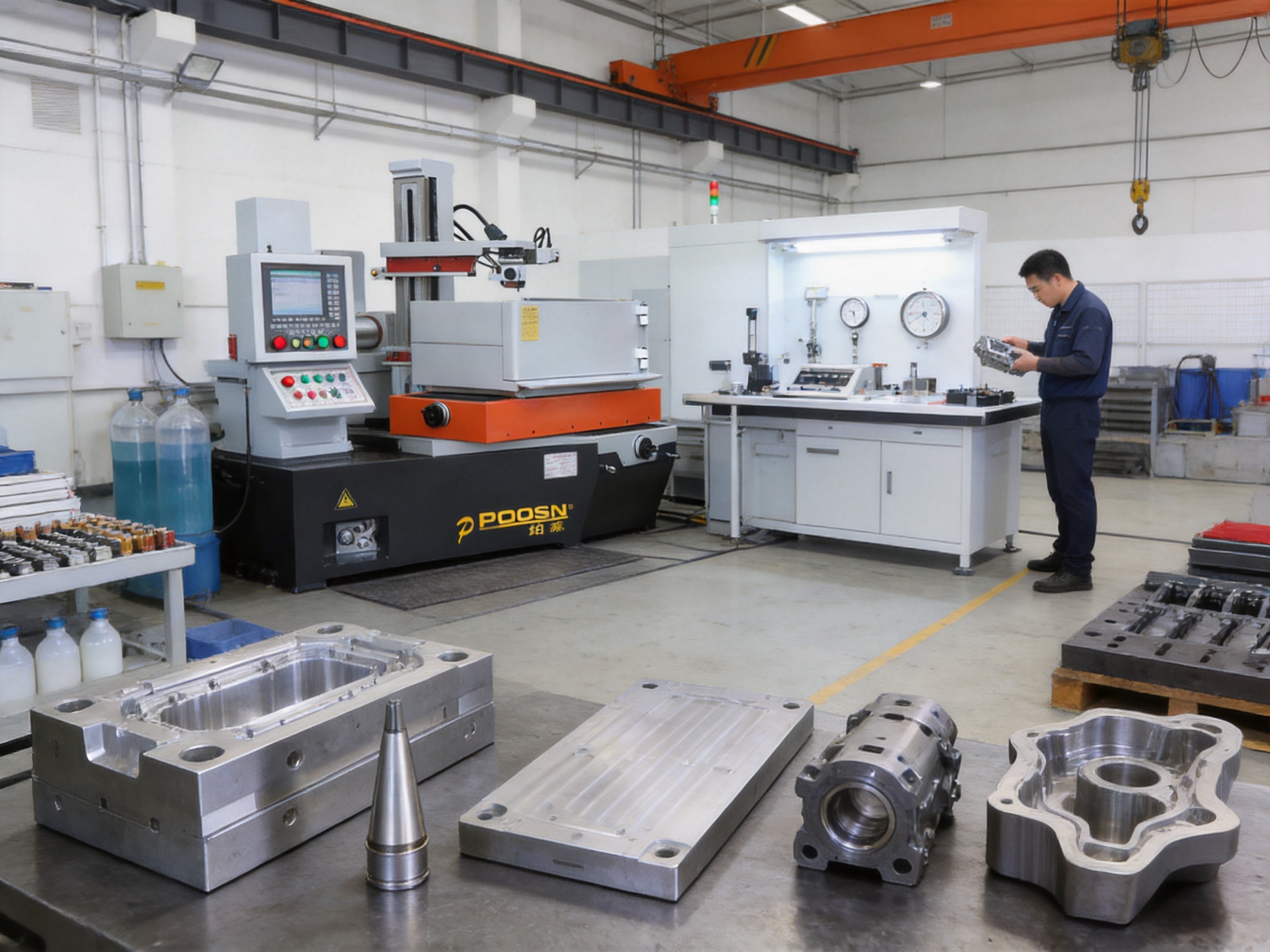
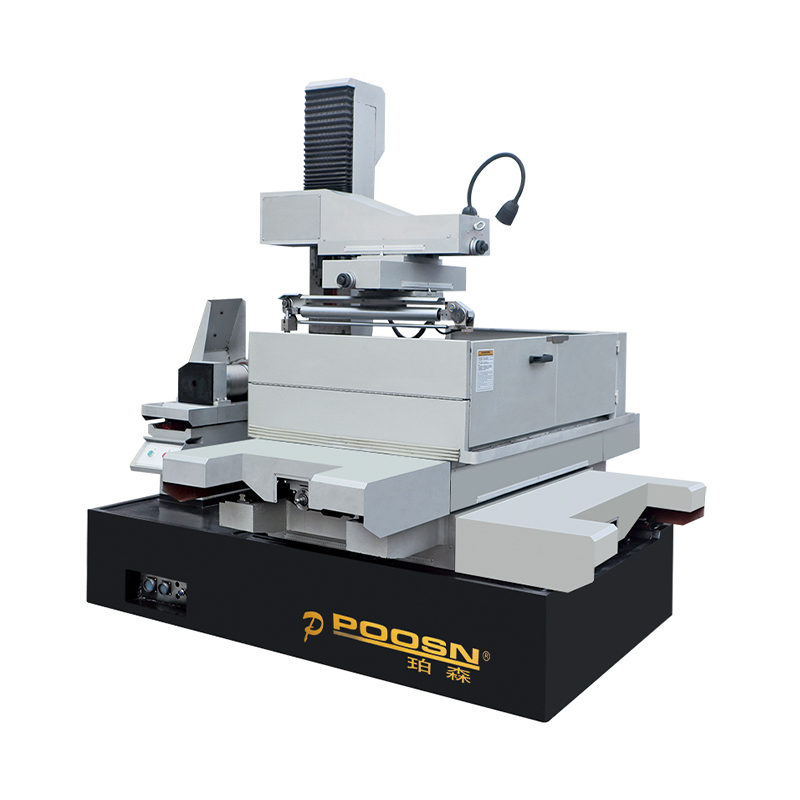
Modern mold production, aerospace manufacturing, and heavy industrial machining increasingly require a wire electrical discharge machining system that can combine large working capacity with dependable precision. The DK60BC CNC Medium-Speed Wire EDM Machine is designed for this demanding production environment. As the largest model in its DK-BC series, it is engineered to process oversized and heavy electrically conductive workpieces while maintaining stable cutting performance, controlled wire movement, and efficient multi-pass machining.
The machine provides a maximum X-axis travel of 600 mm and a maximum Y-axis travel of 800 mm. Its maximum cutting thickness reaches 800 mm, while the worktable supports loads of up to 800 kg. These capabilities make the DK60BC suitable for large dies, thick plates, heavy mechanical components, aerospace parts, and complex tooling that may exceed the practical capacity of smaller wire-cut EDM machines.
Unlike conventional single-pass high-speed wire-cut machines, the DK60BC is developed around a medium-speed architecture that supports improved finishing performance, stable wire control, and multiple cutting passes. This design allows manufacturers to balance material removal rate, surface quality, dimensional consistency, and operating cost within one production platform.
Content
- 1 1. Product Positioning and Primary Applications
- 2 2. Large Work Capacity for Oversized Components
- 3 3. Precision Motion and Four-Axis Taper Control
- 4 4. Medium-Speed Wire EDM Architecture
- 5 5. Adaptive Discharge Control
- 6 6. Wire Feeding and Tension Stability
- 7 7. Machine Structure and Manufacturing Quality
- 8 8. Flushing, Filtration, and Cutting Stability
- 9 9. Advantages Compared with Conventional High-Speed WEDM
- 10 10. Comparison Within the DK-BC Series
- 11 11. Applications in Precision Mold Manufacturing
- 12 12. Applications in Aerospace and Heavy Machinery
- 13 13. Intelligent Operation and Production Efficiency
- 14 14. Options and Custom Configurations
- 15 15. Manufacturing Process and Quality Assurance
- 16 16. Installation, Workshop Conditions, and Maintenance
- 17 17. Total Cost of Ownership
- 18 18. Recommended Selection Checklist
- 19 19. Conclusion
- 20 20. Questions and Answers
- 20.1 Q1: What type of production is the DK60BC best suited for?
- 20.2 Q2: What is the maximum cutting thickness?
- 20.3 Q3: How much weight can the worktable support?
- 20.4 Q4: Can the DK60BC cut taper profiles?
- 20.5 Q5: What surface finish can the machine achieve?
- 20.6 Q6: What control system does the machine use?
- 20.7 Q7: Is the DK60BC suitable for hardened steel and carbide?
- 20.8 Q8: Does the machine require a climate-controlled workshop?
- 20.9 Q9: What options are available?
- 20.10 Q10: How does the DK60BC compare with a high-speed wire EDM?
- 20.11 Q11: What maintenance does the machine require?
- 20.12 Q12: What support is available after purchase?
- 21 References
- 22 Product: DK60BC CNC Medium-Speed Wire EDM Machine (800kg Load, 800mm Thickness)
1. Product Positioning and Primary Applications
The DK60BC occupies an important position between traditional high-speed wire-cut EDM machines and premium low-speed wire EDM systems. Traditional high-speed machines are often selected for economical rough cutting and general-purpose production. Low-speed machines can deliver excellent finish quality, but they normally involve higher equipment investment, higher consumable costs, and more demanding maintenance requirements.
The DK60BC offers a practical medium-speed alternative. It uses a continuously recirculating electrode wire and is equipped with a control system capable of supporting roughing, semi-finishing, and finishing operations. This makes it suitable for manufacturers that need more than basic blanking performance but want to control total ownership cost.
The machine is particularly appropriate for the following production requirements:
Large precision molds and dies that require a substantial work envelope.
Heavy machinery components that cannot be safely or efficiently handled by smaller worktables.
Aerospace components requiring controlled profiles, accurate contours, and stable cutting of difficult alloys.
Thick metal plates and blocks with cutting thicknesses approaching 800 mm.
Complex parts requiring taper cutting through coordinated X, Y, U, and V axis movement.
Small- and medium-batch production where flexible programming and repeatable setup are important.
Manufacturing operations that require multiple cutting passes to improve surface quality and dimensional accuracy.
The DK60BC can process any electrically conductive material suitable for wire EDM. Typical materials include tool steels, stainless steels, hardened alloy steels, cemented carbide, copper alloys, aluminum alloys, titanium alloys, and high-temperature alloys. Material hardness does not prevent EDM cutting; the main process factors are electrical conductivity, melting behavior, thickness, flushing conditions, and selected discharge parameters.
2. Large Work Capacity for Oversized Components
The most visible advantage of the DK60BC is its large working capacity. The machine provides a worktable size of approximately 840 × 1160 mm and an effective XY travel of 600 × 800 mm. The processing slot is approximately 860 × 1200 mm, offering additional space for positioning fixtures and large workpieces.
A maximum cutting thickness of 800 mm enables the machine to address applications that are outside the normal range of compact or general-purpose wire EDM equipment. Thick workpieces present significant technical challenges. The electrode wire must remain stable over a long cutting depth, debris must be removed from the kerf, flushing pressure must be controlled, and wire lag must be minimized to maintain profile accuracy through the full thickness.
The DK60BC is designed to address these challenges through a rigid machine structure, reinforced wire support, controlled wire tension, and high-pressure flushing options. These features help maintain a stable discharge gap and reduce the risk of unstable machining when processing deep or heavy sections.
The 800 kg maximum worktable load is also important for production planning. Large molds and heavy mechanical parts can be positioned directly on the machine without requiring the manufacturer to divide the job into multiple operations. Reducing the number of setups can improve repeatability, reduce alignment errors, and shorten total processing time.
Proper workholding remains essential. The rated load should be distributed evenly, and the actual workpiece weight should be considered together with fixtures, clamps, and auxiliary supports. For especially heavy components, the production team should confirm foundation requirements, lifting arrangements, table loading procedures, and machine installation conditions before commissioning.
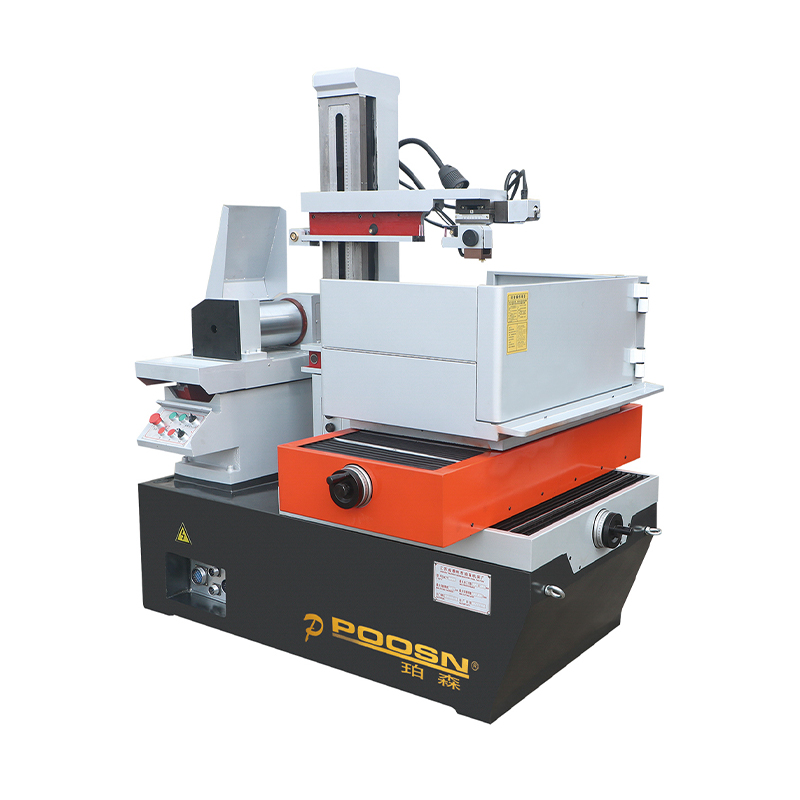
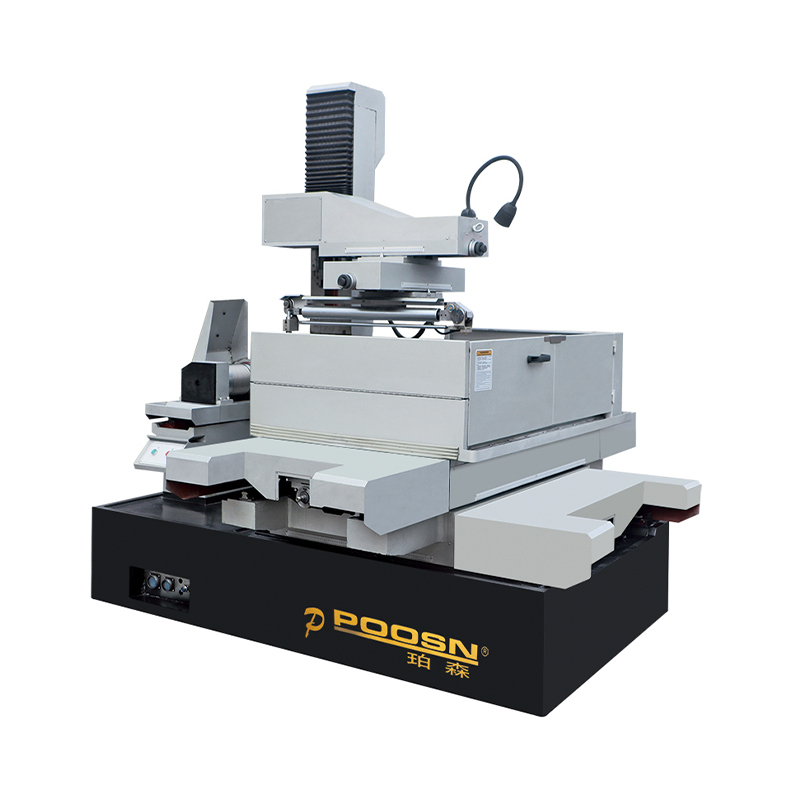
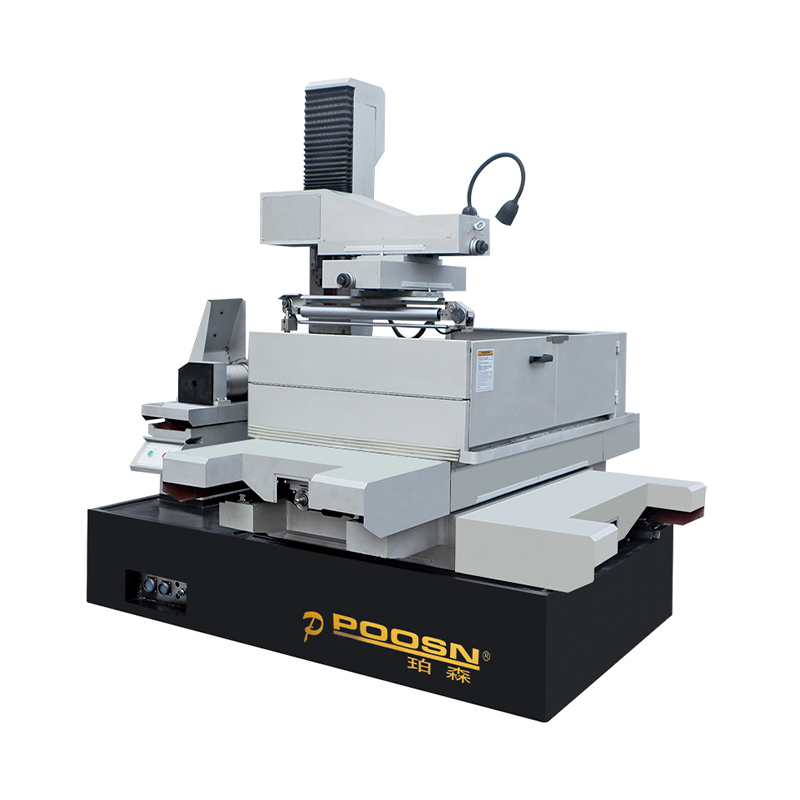
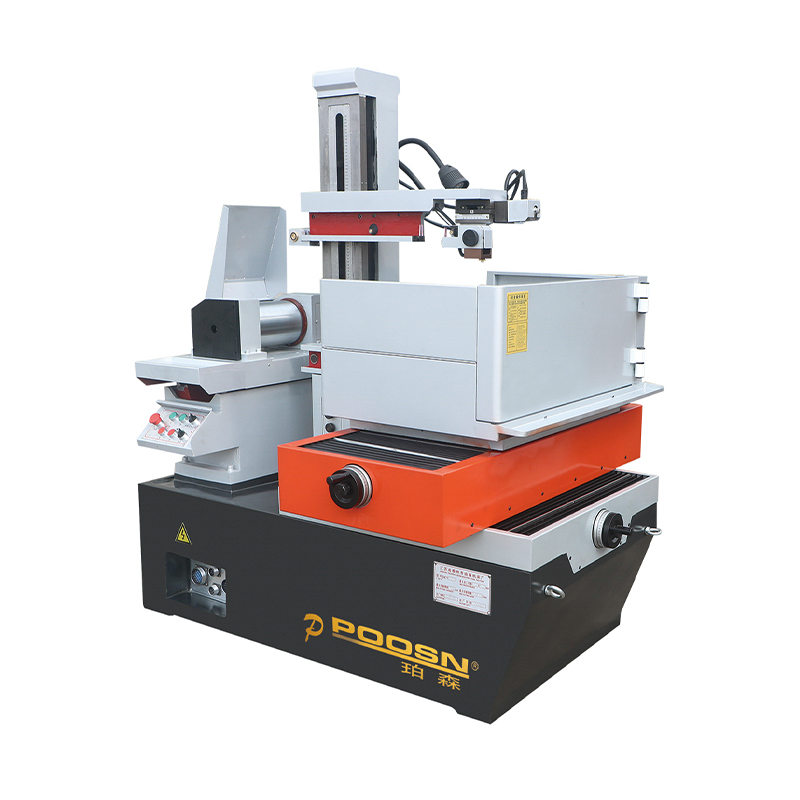
DK60BC CNC Medium-Speed Wire EDM Machine (800kg Load, 800mm Thickness)
3. Precision Motion and Four-Axis Taper Control
The DK60BC uses coordinated X, Y, U, and V axis movement for contour cutting and taper machining. The main X and Y axes control the worktable position, while the U and V axes control the upper and lower guide relationships. This arrangement allows the machine to cut profiles that are not identical at the top and bottom of the workpiece.
The standard taper device provides U/V travel of approximately 60 × 60 mm and a maximum taper capability of approximately ±6° over 80 mm of thickness. This capability is useful for die relief angles, punch and die profiles, mold inserts, formed components, and other applications in which the upper and lower contours must be intentionally offset.
For applications requiring substantially larger taper angles, an optional large-taper configuration can be considered. The supplied product information identifies a DKD-style large-taper upgrade for angles up to approximately ±30°, depending on the application and engineering configuration. Extreme taper applications should be reviewed by the technical team because the suitable guide assembly, cutting parameters, workpiece geometry, and flushing arrangement depend on the actual profile.
The machine’s specified processing accuracy is based on GB/T 7926-2015. Product information identifies linear accuracy values in the range of 0.005 mm for the DK60BC configuration, while other DK-BC series information cites positioning accuracy as fine as 0.002 mm under specified control, calibration, and configuration conditions. Actual results depend on machine configuration, environmental stability, material, workpiece thickness, wire condition, programming, workholding, and cutting strategy.
For manufacturers requiring additional feedback control, a linear scale is available as an option. Glass-scale or linear-scale feedback can improve position verification and repeatability in applications with particularly tight tolerance requirements. It is most valuable when combined with a stable workshop temperature, careful machine leveling, proper maintenance, and a validated cutting process.
4. Medium-Speed Wire EDM Architecture
The DK60BC is built around a medium-speed wire-cutting concept. Its electrode wire has a nominal diameter of 0.18 mm with a guide device, and the wire feed speed is frequency-controlled over a range of approximately 1 to 11 m/s. The maximum wire storage length is approximately 350 m, and the wire storage tube travel is approximately 180 mm.
Medium-speed wire EDM differs from traditional single-pass high-speed cutting in both process strategy and output expectations. A rough cut removes most of the material efficiently. Additional semi-finishing and finishing passes then refine the contour, reduce the effect of roughing marks, and improve the final surface condition. This multi-pass approach is especially useful in precision mold manufacturing, where a stable mating fit and a controlled surface are more important than simply achieving the fastest initial cut.
The product information specifies a maximum cutting efficiency of approximately 10,000 to 16,000 mm²/h. This figure should be treated as a process reference rather than a universal production guarantee. Actual cutting efficiency depends on workpiece material, thickness, flushing, wire condition, selected control cabinet, discharge parameters, surface-finish target, and the number of required passes.
The best stated surface roughness for the standard configuration is approximately Ra ≤ 2.5 μm. Additional process optimization and finishing passes may produce improved results under suitable conditions. Surface roughness, recast layer, dimensional accuracy, and edge quality should always be confirmed through sample cutting when a specific customer tolerance or surface specification is critical.
5. Adaptive Discharge Control
Stable electrical discharge is central to wire EDM performance. The DK60BC uses the X8 and AUTOCUT control system family to manage programming, cutting parameters, wire movement, and machining control. The system is designed to monitor the discharge condition and adjust the process to help maintain a stable gap between the electrode wire and the workpiece.
During rough cutting, the control strategy can prioritize material removal. Higher-energy pulses and suitable feed control allow the machine to remove material efficiently. During finishing, the process can use lower-energy pulses and more controlled cutting conditions to reduce surface damage and improve contour quality.
Adaptive control is particularly valuable when cutting thick sections. The discharge environment can change as debris accumulates, flushing conditions vary, or the wire passes through different material geometries. Real-time monitoring and feed adjustment can help reduce unstable arcs, wire breakage, and unnecessary pauses.
The control system also supports process standardization. Instead of requiring operators to manually develop every cutting parameter from the beginning, a process database can provide starting conditions based on material type, thickness, and intended cutting result. Experienced technicians can further refine the parameters for specialized applications, while newer operators can follow a more structured setup procedure.
Available programming functions include graphical path creation, imported drawing data, automatic edge finding, centering functions, multi-pass cutting profiles, and data transfer through USB or network connections, depending on the selected control configuration. These features can shorten setup time and reduce the risk of manual programming errors.
6. Wire Feeding and Tension Stability
Wire stability has a direct effect on straightness, slit consistency, taper accuracy, and surface quality. A wire that vibrates or deviates from its intended path can create dimensional errors, especially in thick workpieces or during changes in cutting direction.
The DK60BC incorporates an optimized wire-feeding path with guide wheels and wire guides designed to maintain stable electrode movement. The machine information also describes a constant-tension dynamic compensation concept. By controlling wire tension during reciprocating movement, the system helps suppress vibration and jitter while keeping the electrode wire aligned through the machining zone.
Stable wire tension is particularly important for thick cutting. As the wire travels through a deep kerf, even a small deviation can produce a larger error at the bottom of the workpiece. Reinforced guide wheel assemblies, precision wire guides, and controlled tension work together to reduce this effect.
The machine is equipped with waterproof guide wheel technology and guide components designed for practical operation. A quick or easy wire-threading arrangement can reduce setup time when the wire must be replaced or rethreaded after a break. The guide system should be cleaned regularly because accumulated debris and residue can influence wire tracking and electrical stability.
For workpieces above approximately 400 mm thickness, process engineering may recommend a larger wire diameter, such as 0.20 to 0.25 mm, where compatible with the selected guide system and machine configuration. The correct wire size should be chosen according to workpiece material, thickness, corner requirements, taper, desired finish, and the manufacturer’s process recommendations.
7. Machine Structure and Manufacturing Quality
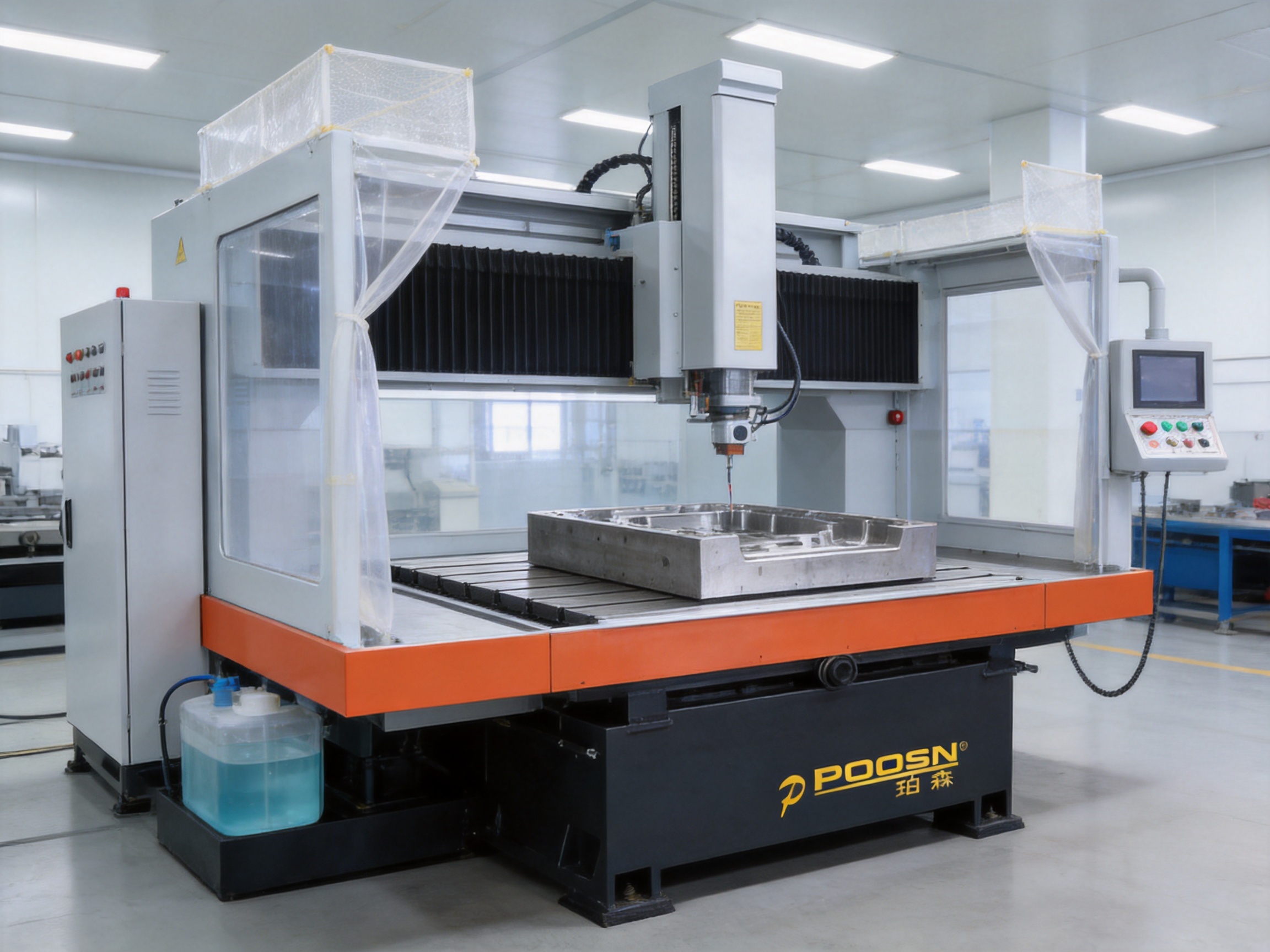
A high-capacity wire EDM machine requires more than a large table. The machine body must resist deformation, maintain alignment, and absorb vibration during long machining cycles. The DK60BC uses a high-strength cast structure with reinforced ribbing. The machine body is designed to provide the stiffness required for heavy workpieces and extended cutting operations.
Long-duration aging treatment of castings is an important part of the manufacturing process. Casting materials contain internal stresses that can gradually release during service, potentially affecting dimensional stability. Controlled aging helps reduce this risk before final machining and assembly. A stable machine bed provides a stronger foundation for guide rail alignment, screw installation, wire frame positioning, and accuracy verification.
The company’s manufacturing approach combines traditional mechanical production experience with modern EDM equipment development. Taizhou Xinchengyang Machinery Manufacturing Co., Ltd. reports that its production process includes advanced machining equipment, comprehensive testing methods, and quality inspection throughout the manufacturing cycle. Components are checked from warehouse entry through assembly, adjustment, and final testing.
High-precision linear guide rails support the CNC worktable. Linear guide systems offer low friction, predictable movement, and good repeatability when correctly installed and maintained. Compared with simple sliding guide structures, linear guides can provide smoother axis movement and improved support for medium-speed precision cutting. Their performance still depends on correct lubrication, protection from contamination, proper preload, and accurate installation.
The drive system is available with standard X/Y stepper drives or optional AC servo drives. Stepper drives can provide a cost-effective solution for general applications. AC servo drives may be preferred for applications that demand faster response, more advanced feedback, and enhanced dynamic control. The appropriate choice depends on the workpiece, production volume, tolerance requirements, and customer automation strategy.
Before delivery, each machine undergoes positioning accuracy testing. The company also describes the use of laser interferometer verification and ballbar testing for configured machines and selected precision requirements. These tests help evaluate axis positioning, repeatability, geometric behavior, and circular interpolation performance. Testing does not replace correct installation, but it establishes a documented baseline for machine performance.
8. Flushing, Filtration, and Cutting Stability
Efficient flushing is essential when cutting thick materials. EDM debris must be removed from the discharge gap so that the spark remains controlled. If debris accumulates, unstable discharge, short circuits, wire breakage, surface defects, and reduced cutting speed may occur.
The DK60BC supports a high-pressure water tank as an optional configuration. High-pressure flushing can improve debris removal around the upper and lower portions of a thick workpiece. The water nozzle geometry and pressure should be adjusted carefully because excessive or poorly directed flushing can disturb the wire or create an uneven cutting condition.
The machine architecture also incorporates a filtration approach intended to maintain a clean dielectric environment. Effective filtration contributes to stable conductivity, consistent discharge behavior, and longer service life for pumps, valves, guide components, and other fluid-contact parts. Regular filter inspection and fluid management remain necessary even when the machine is equipped with advanced filtration.
Water quality should be monitored according to the machine supplier’s recommendations. Conductivity, contamination, temperature, and fluid condition can all influence cutting performance. A clean tank, properly serviced filters, and timely replacement of consumables help maintain consistent results across long production runs.
For thick workpieces, both upper and lower flushing should be checked before machining. The workpiece should be positioned so that the water flow can reach the cutting region. Fixtures must not obstruct the nozzle or prevent debris from leaving the kerf. These practical details are often as important as the nominal power rating when determining actual production performance.
9. Advantages Compared with Conventional High-Speed WEDM
The DK60BC offers several advantages over conventional high-speed wire-cut machines used primarily for single-pass rough cutting.
First, its medium-speed process supports multiple cutting passes. A rough pass can be followed by semi-finishing and finishing passes, improving contour consistency and reducing the visible cutting pattern. This is valuable when a component must fit another precision part or when the surface will be used directly in a mold or die.
Second, the DK60BC uses linear guide support rather than relying only on traditional sliding guide arrangements. Properly maintained linear guides can provide smoother movement, lower friction, and more consistent axis response.
Third, the DK60BC is designed for considerably greater workpiece thickness and load capacity than many general-purpose high-speed machines. Its 800 mm cutting thickness and 800 kg maximum table load provide a practical advantage for heavy components.
Fourth, its four-axis linkage supports taper cutting and complex upper-to-lower profile relationships. This provides greater flexibility than a basic two-axis cutting arrangement.
Fifth, the adaptive control concept helps regulate cutting conditions in response to changes in the discharge gap. This can improve process stability and reduce the need for constant manual intervention.
Compared with premium low-speed wire EDM systems, the DK60BC may offer lower acquisition and operating costs while retaining a medium-speed multi-pass process. Its consumables, wire handling system, and control architecture are intended to provide an economical solution for manufacturers that require precision but do not need every feature of a high-end imported slow-wire platform.
The best machine choice depends on the application. A low-speed machine may remain preferable for extremely demanding finish, micron-level tolerance, automatic threading, or highly specialized unattended production. The DK60BC is most attractive when large capacity, thick cutting, multiple-pass finishing, and controlled investment are required together.
| Feature | DK60BC Medium-Speed WEDM | Traditional High-Speed WEDM | Typical Low-Speed WEDM |
| Process strategy | Roughing with optional multiple finishing passes | Primarily single-pass rough cutting | Multi-pass precision cutting |
| Large-workpiece capability | Up to 800 mm cutting thickness and 800 kg load | Usually lower, depending on model | Varies by model and configuration |
| Guide support | High-precision linear guide system | Often sliding guide construction | Precision guide system |
| Taper control | Four-axis X/Y/U/V linkage, standard taper device | Basic taper capability on selected models | Advanced taper capability depending on model |
| Operating cost | Moderate, with economical wire and consumables | Generally economical | Usually higher |
| Best application | Large molds, thick parts, precision industrial components | Rough cutting and general blanking | High-end precision finishing and unattended production |
10. Comparison Within the DK-BC Series
The DK60BC is the largest model in the DK-BC family. The smaller DK35BC, DK45BC, and DK50BC models share the same general medium-speed design philosophy but are intended for different workpiece sizes and weights.
The DK35BC provides an XY travel of approximately 350 × 450 mm, a maximum cutting thickness of 450 mm, and a maximum worktable load of approximately 300 kg. It is suitable for small precision parts, compact dies, electrodes, and smaller production batches.
The DK45BC provides approximately 450 × 600 mm of XY travel, a 450 mm maximum cutting thickness, and a 400 kg worktable load. It is appropriate for medium molds, mechanical components, and automotive tooling requiring more capacity than the DK35BC.
The DK50BC expands the travel to approximately 500 × 700 mm, increases maximum cutting thickness to 650 mm, and supports loads up to 600 kg. It is an attractive choice for large molds and thick workpieces that do not require the full capacity of the DK60BC.
The DK60BC provides the largest working envelope, the highest load capacity, and the greatest cutting thickness in the series. It is the appropriate choice when the production line frequently handles oversized molds, heavy industrial components, thick plates, or large aerospace parts.
| Model | XY Travel | Maximum Cutting Thickness | Maximum Worktable Load | Recommended Application |
| DK35BC | 350 × 450 mm | 450 mm | 300 kg | Small precision parts and compact dies |
| DK45BC | 450 × 600 mm | 450 mm | 400 kg | Medium molds and mechanical parts |
| DK50BC | 500 × 700 mm | 650 mm | 600 kg | Large molds and thick workpieces |
| DK60BC | 600 × 800 mm | 800 mm | 800 kg | Oversized molds and heavy industrial parts |
Model selection should be based not only on maximum workpiece dimensions but also on future production requirements. If a customer currently processes medium parts but expects to introduce large dies or heavier components, selecting the DK60BC may avoid an equipment upgrade later. Conversely, a smaller model may provide better space and investment efficiency when large capacity is not needed.
11. Applications in Precision Mold Manufacturing
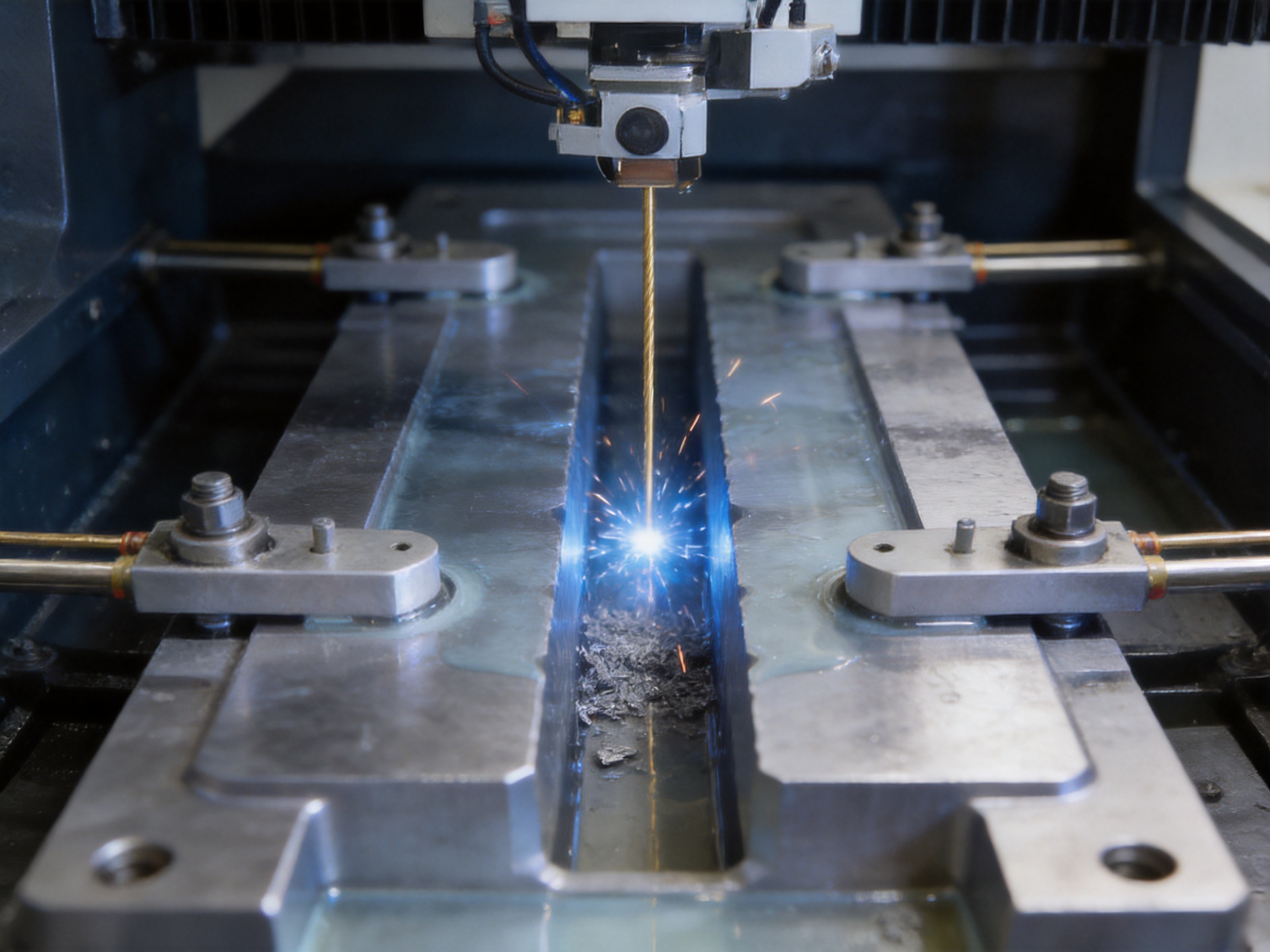
Large mold manufacturing is one of the strongest application areas for the DK60BC. Mold components often require accurate profiles, sharp internal corners, precise mating surfaces, and repeatable dimensions. The ability to use several cutting passes helps separate rough material removal from final profile refinement.
For a large punch or die, the operator may begin with a rough cut that leaves a controlled amount of material for finishing. A semi-finishing pass can stabilize the profile, followed by one or more finishing passes to achieve the required dimensional and surface condition. This strategy can reduce the effect of rough-cut stress and improve the final fit between mating components.
The machine’s taper function is useful for mold inserts and dies in which the sidewall must be relieved or angled. The X/Y/U/V system can produce a controlled relationship between the upper and lower profiles, provided that the program, wire guide condition, and workpiece setup are correct.
Large molds also benefit from the DK60BC’s 800 kg table capacity. A mold base or die block can be secured with suitable fixtures and processed without being divided into smaller pieces. Fewer setup changes can improve alignment consistency and reduce the chance of cumulative errors.
When mold surface quality is critical, the manufacturer should define the target roughness, recast-layer requirement, dimensional tolerance, corner radius, and inspection method before cutting. Sample testing is recommended for unfamiliar materials or unusually thick sections.
12. Applications in Aerospace and Heavy Machinery
Aerospace manufacturing often involves difficult-to-machine conductive alloys, complex profiles, and strict documentation requirements. Wire EDM can cut hardened materials without generating conventional cutting forces, making it suitable for thin sections, intricate contours, and components that would be difficult to machine with a rotating tool.
The DK60BC’s large capacity allows it to process substantial components and thick stock. Its adaptive discharge control and multi-pass strategy can support the production of brackets, templates, tooling components, blades, fixtures, and other electrically conductive parts. Aerospace production should use validated cutting parameters and documented inspection procedures because the acceptable result may depend on more than dimensional accuracy alone.
Heavy machinery manufacturers can use the DK60BC for gears, wear plates, guides, fixtures, structural inserts, and large tooling elements. The 800 kg load capacity is especially valuable when workpieces are difficult to divide or when their mass makes repeated handling impractical.
The machine can also process hardened tool steels and cemented carbide without softening the material before cutting. This can reduce the need for additional heat-treatment or grinding operations, depending on the component design. EDM does not eliminate the need for subsequent finishing in every application, but it can simplify the production route for complex profiles.
13. Intelligent Operation and Production Efficiency
Ease of operation is an important factor in production cost. A machine that requires extensive manual parameter development may place a heavy burden on a small number of experienced technicians. The DK60BC’s graphical programming and process database approach is intended to make routine operation more structured.
Operators can prepare cutting programs from imported drawing data or graphical geometry, establish workpiece coordinates, use edge-finding or centering functions, and select roughing or finishing routines. USB and LAN connectivity can simplify the transfer of programs from engineering or CAM workstations, subject to the selected controller configuration.
Automatic parameter adjustment can help maintain feed stability when the discharge condition changes. If the wire approaches an unstable state, the controller may reduce feed or modify the cutting response to protect the process. This can reduce manual monitoring and help prevent avoidable wire breakage.
Production efficiency should be assessed across the complete job rather than by maximum cutting speed alone. Setup time, workholding, programming, wire threading, finishing passes, inspection, cleaning, and rework all affect throughput. The DK60BC can contribute to productivity by combining large capacity, multi-pass cutting, process support, and reduced setup frequency.
The machine can also support production standardization. Once a material and thickness have been validated, the corresponding cutting conditions can be stored for repeated jobs. This makes it easier to reproduce results across operators and shifts.
14. Options and Custom Configurations
The DK60BC can be configured to suit different production objectives. The standard machine includes high-precision linear rail support and an environmentally oriented waterproof cover. Optional equipment may include a high-pressure water tank, linear scale feedback, AC servo drives, and an alternative control cabinet.
The standard control cabinet is identified as ZHZK-03, while ZHZ-09G is available as an optional configuration. The final control package should be selected according to programming requirements, feedback expectations, automation plans, and regional electrical standards.
Other possible customizations include extended X/Y travel, large-taper wire frame upgrades, automatic wire threading, closed-loop glass-scale feedback, rotary-table integration, and certification packages for specific markets. Custom configurations require technical review because changes to one subsystem may influence machine dimensions, electrical capacity, software functions, installation requirements, and delivery time.
Automatic wire threading can be valuable for multi-cavity mold production or unattended operation. A rotary table may be appropriate for cylindrical, spiral, or specialized contour cutting. Closed-loop feedback is beneficial where sub-micron repeatability or detailed position verification is required.
Customers should provide workpiece drawings, material information, maximum thickness, target taper, tolerance, finish requirement, production volume, available power supply, and workshop conditions when requesting a customized proposal. This information allows the manufacturer to recommend a configuration based on the actual process rather than on nominal machine size alone.
15. Manufacturing Process and Quality Assurance
Taizhou Xinchengyang Machinery Manufacturing Co., Ltd. has specialized in electrical discharge wire cutting since 1999 and developed the POOSN brand in 2003. The company later established its current manufacturing organization in 2017 with a registered capital of 60 million yuan and its own factory facilities.
The company’s production scope includes medium-speed wire-cut EDM, high-speed wire-cut EDM, large-taper wire-cut EDM, and related special-processing equipment. Its product development combines machine design, electrical control, mechanical transmission, wire transport, and process application experience.
A complete manufacturing process begins with controlled component procurement and inspection. Castings, guide rails, screws, motors, electrical components, pumps, wire guides, and control cabinets must meet the requirements of the selected machine configuration. Inspection at the incoming stage helps prevent defects from being carried into final assembly.
After machining and aging, the machine bed and structural components are assembled with careful attention to alignment. Guide rails and transmission components must be positioned accurately, while the wire frame must be aligned relative to the table and machining zone. Electrical wiring, control cabinets, pumps, sensors, and safety components are then integrated and tested.
Final inspection includes functional operation, axis movement, wire running, water circulation, control response, and cutting verification. Accuracy testing may include laser interferometer measurement and ballbar circularity evaluation. A factory test cut can also verify the relationship between programmed geometry and produced geometry.
This full-process approach is important for large machines because performance depends on the interaction of many systems. A precise control cabinet cannot compensate for poor mechanical alignment, and a rigid machine structure cannot deliver its potential if the wire guides, flushing, or electrical parameters are incorrectly configured.
The company also reports experience exporting products to Southeast Asia, West Asia, Europe, and the Americas. Export capability requires attention to packaging, electrical standards, documentation, remote support, spare parts, and installation guidance.
16. Installation, Workshop Conditions, and Maintenance
Although the DK60BC is designed for general industrial workshop use, the best precision results are obtained in a clean and stable environment. Large temperature changes can influence machine geometry, workpiece dimensions, wire tension, dielectric temperature, and measurement results.
For general production, the machine can operate in a normal workshop environment within the recommended temperature range. For very tight tolerances, a temperature-controlled room is advisable. Strong vibration sources, unstable foundations, excessive dust, and large temperature fluctuations should be avoided.
The machine should be installed on a suitable foundation that can support its approximately 2,500 kg weight and account for dynamic loads, working access, lifting paths, and service clearance. The overall host dimensions are approximately 2400 × 2065 × 2200 mm, excluding any additional space required for the control cabinet, operator access, material handling, and maintenance.
Routine maintenance includes cleaning the worktable and tank, checking guide wheels and wire guides, inspecting water nozzles, maintaining filters, checking wire tension, monitoring dielectric condition, lubricating or servicing guide systems, and confirming electrical connections. Preventive maintenance is less expensive than correcting a dimensional problem after a long production run.
Operators should also inspect the wire path before each important job. Small particles, damaged guide surfaces, incorrect threading, or abnormal wheel rotation can affect accuracy and increase the risk of wire breakage.
The machine is supplied with remote technical support and spare-parts assistance. The stated warranty period is 12 months from shipment, while critical spare parts can be dispatched by express service depending on availability and destination. Remote support through video communication can help local technicians diagnose control, wiring, water circulation, and wire-running issues.
17. Total Cost of Ownership
Acquisition price is only one part of the cost of a wire EDM system. A more complete evaluation includes wire consumption, guide wheels, nozzles, filters, dielectric fluid, resin, electricity, labor, maintenance, downtime, and finishing requirements.
The DK60BC is designed to provide economical operation through medium-speed wire use, multiple-pass capability, process standardization, and accessible consumables. Compared with many imported precision wire EDM systems, its consumable and service costs may be lower, although the exact result depends on local prices, cutting conditions, machine utilization, and maintenance practices.
Multiple cutting passes can increase machining time compared with a single roughing pass, but they may reduce downstream grinding, fitting, polishing, or manual correction. The correct comparison is therefore the total manufacturing route rather than the duration of the first cutting pass.
Large capacity can also improve cost efficiency. If a smaller machine requires a large component to be divided into sections, the additional fixturing, alignment, welding, grinding, or secondary machining may exceed the cost difference between machine sizes. The DK60BC can reduce such secondary operations when the complete workpiece fits within its travel and load limits.
18. Recommended Selection Checklist
Before purchasing or configuring a DK60BC, the customer should review several technical points.
Confirm the largest workpiece length, width, height, and weight, including all fixtures and clamps.
Confirm the maximum cutting thickness and whether the part requires through-cutting or partial-depth machining.
Define the required linear tolerance, taper accuracy, surface roughness, and inspection method.
Identify the material group, hardness, conductivity, heat-treatment state, and expected cutting volume.
Determine whether standard X/Y stepper drives are sufficient or whether AC servo drives are preferred.
Evaluate the need for linear-scale feedback, high-pressure flushing, automatic wire threading, or a large-taper configuration.
Check the available three-phase power supply, workshop floor capacity, lifting equipment, ventilation, and water management.
Discuss training, installation, spare parts, warranty coverage, and remote technical support.
Request a sample cut when the application involves unusual thickness, difficult alloys, extremely tight tolerances, or complex taper geometry.
19. Conclusion
The DK60BC CNC Medium-Speed Wire EDM Machine is designed for manufacturers that need large capacity without giving up the advantages of controlled, precision-oriented wire cutting. Its 600 × 800 mm XY travel, 800 mm maximum cutting thickness, and 800 kg load capacity make it particularly suitable for oversized molds, aerospace tooling, heavy machinery components, and thick conductive workpieces.
Its main technical strengths include four-axis taper linkage, high-precision linear guides, adaptive discharge control, stable wire feeding, optional high-pressure flushing, multi-pass cutting, and a control system designed to simplify programming and process management.
Compared with conventional high-speed wire-cut machines, the DK60BC provides stronger finishing capability and greater large-workpiece flexibility. Compared with premium low-speed systems, it offers a potentially more economical medium-speed solution for manufacturers that require precision, capacity, and practical operating costs.
The performance of any wire EDM machine depends on correct installation, workholding, wire condition, water quality, parameter selection, temperature stability, and operator discipline. When these conditions are properly managed, the DK60BC can become a productive and reliable platform for demanding industrial machining.
Supported by Taizhou Xinchengyang Machinery Manufacturing Co., Ltd.’s experience in electrical discharge machining, controlled manufacturing process, inspection procedures, export experience, and technical support, the DK60BC represents a strong option for customers seeking a high-capacity wire erosion machine for precision production.
20. Questions and Answers
Q1: What type of production is the DK60BC best suited for?
The DK60BC is best suited for large and heavy electrically conductive workpieces. Typical applications include oversized molds, aerospace tooling, heavy machinery components, thick plates, large dies, and precision parts requiring taper cutting or multiple finishing passes.
Q2: What is the maximum cutting thickness?
The maximum stated cutting thickness is 800 mm. Actual results depend on material, workpiece geometry, flushing, wire condition, cutting parameters, and the required accuracy and surface finish.
Q3: How much weight can the worktable support?
The maximum worktable load is approximately 800 kg. The load should be distributed correctly, and the combined weight of the workpiece, fixtures, clamps, and supports should be considered.
Q4: Can the DK60BC cut taper profiles?
Yes. The machine uses coordinated X, Y, U, and V axis movement. The standard taper device provides approximately 60 × 60 mm of U/V travel and a maximum taper of approximately ±6° over 80 mm. Larger taper configurations may be available as an option.
Q5: What surface finish can the machine achieve?
The standard product information specifies an optimal surface roughness of approximately Ra ≤ 2.5 μm. The final result depends on material, thickness, cutting strategy, number of finishing passes, wire condition, and control parameters.
Q6: What control system does the machine use?
The machine uses the X8 and AUTOCUT programming control system family. The standard control cabinet is identified as ZHZK-03, with ZHZ-09G available as an option. The final configuration should be confirmed in the quotation and technical specification.
Q7: Is the DK60BC suitable for hardened steel and carbide?
Yes. Wire EDM can process electrically conductive hardened materials without conventional cutting tools. Suitable materials may include hardened tool steel, stainless steel, cemented carbide, titanium alloys, copper alloys, aluminum alloys, and high-temperature alloys.
Q8: Does the machine require a climate-controlled workshop?
A stable workshop is recommended for high precision. The machine is designed for general industrial environments, but temperature fluctuations, vibration, dust, and unstable power can affect accuracy and reliability. For very tight tolerances, temperature control and optional linear-scale feedback should be considered.
Q9: What options are available?
Options may include a high-pressure water tank, linear scale, AC servo drives, upgraded control cabinets, automatic wire threading, large-taper wire frames, extended travel, rotary tables, glass-scale feedback, and certification packages. Availability depends on the application and final machine configuration.
Q10: How does the DK60BC compare with a high-speed wire EDM?
The DK60BC is designed for medium-speed, multi-pass cutting and precision finishing, while many conventional high-speed machines focus on economical single-pass rough cutting. The DK60BC also provides greater large-workpiece capacity, linear guide support, adaptive control, and improved flexibility for precision molds and heavy parts.
Q11: What maintenance does the machine require?
Routine maintenance includes cleaning the tank and worktable, checking wire guides and guide wheels, inspecting water nozzles, maintaining filters, monitoring dielectric condition, checking wire tension, and servicing the motion system. Preventive maintenance helps protect accuracy and reduce downtime.
Q12: What support is available after purchase?
The manufacturer provides technical support, remote assistance, spare-parts service, and operating guidance. The stated warranty is 12 months from shipment, and remote troubleshooting can be conducted through video communication when required.
References
1. Taizhou Xinchengyang Machinery Manufacturing Co., Ltd., DK-BC Series Medium-Speed Wire EDM Technical Specifications.
2. Taizhou Xinchengyang Machinery Manufacturing Co., Ltd., DK60BC Product Application and Configuration Information.
3. GB/T 7926-2015, Accuracy of Wire-Cut Electrical Discharge Machines.
4. Manufacturer-provided information on X8 and AUTOCUT CNC control systems.
5. Manufacturer-provided information on wire feeding, taper cutting, high-pressure flushing, and linear-scale options.
6. General technical principles of wire electrical discharge machining, including discharge-gap control, dielectric flushing, electrode-wire tension, and multi-pass finishing.
Product: DK60BC CNC Medium-Speed Wire EDM Machine (800kg Load, 800mm Thickness)
-
Phone
+86-0523-86268788 +86-13815960366 +86-13912191163Email
[email protected]Address
No. 366, Yusheng Road Jiulong Town, Hailing District Taizhou City, China
Copyright © Taizhou Xinchengyang Machinery Manufacturing Co., Ltd. All Rights Reserved.
Custom edm machine for sale
wholesale edm machine manufacturers
