

 English
 русский
 عربى
عربى

Lu Qianwen — Overseas Sales Manager
Home / Author / Lu Qianwen — Overseas Sales Manager / DK45BC High-Medium-Speed Wire EDM Machine for Large and Precision Workpieces
DK45BC High-Medium-Speed Wire EDM Machine for Large and Precision Workpieces
2026-08-11
In modern mold manufacturing, automotive tooling, aerospace production, and precision component processing, wire electrical discharge machining has become an essential technology for cutting electrically conductive materials that are difficult to machine by conventional methods. Complex contours, narrow slots, hardened tool steels, carbide, titanium alloys, and thick workpieces can all present serious challenges for milling, sawing, or grinding. A medium-speed wire-cut EDM machine addresses these challenges by using controlled electrical discharges between a moving electrode wire and the workpiece, allowing material to be removed without direct mechanical cutting forces.
The DK45BC CNC Medium-Speed Wire EDM Machine is designed for manufacturers that require a larger work area, higher worktable capacity, stable cutting performance, and the flexibility of multi-pass machining. With an X-axis travel of 450 mm, a Y-axis travel of 600 mm, a maximum cutting thickness of 450 mm, and a maximum worktable load of 400 kg, the machine occupies an important position between compact precision wire EDM equipment and larger heavy-duty models.
Its design combines a rigid machine structure, high-precision linear guide support, a programmable wire-feed system, four-axis linkage, an X8/AUTOCUT control platform, and optional upgrades such as AC servo drives, linear scales, and high-pressure water systems. These features make the DK45BC suitable for medium-sized molds, mechanical components, automotive tooling, and other demanding applications where productivity and dimensional stability must be balanced.
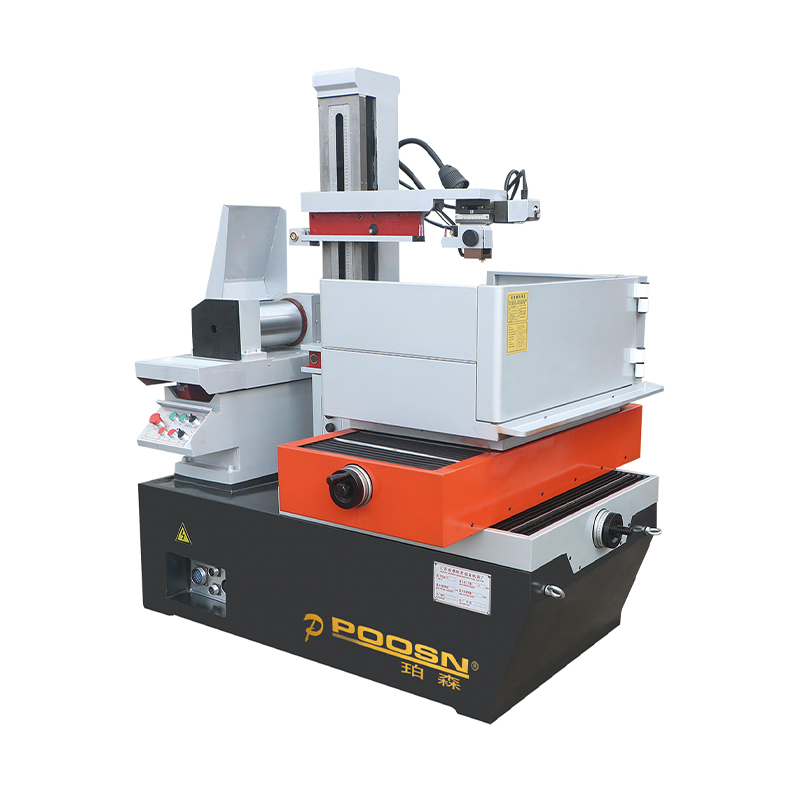
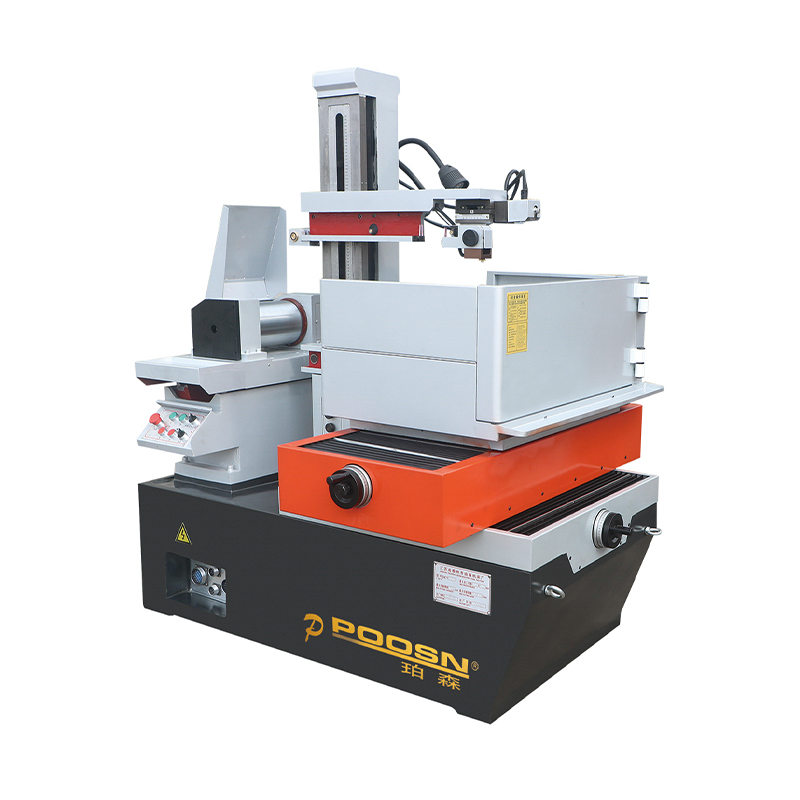
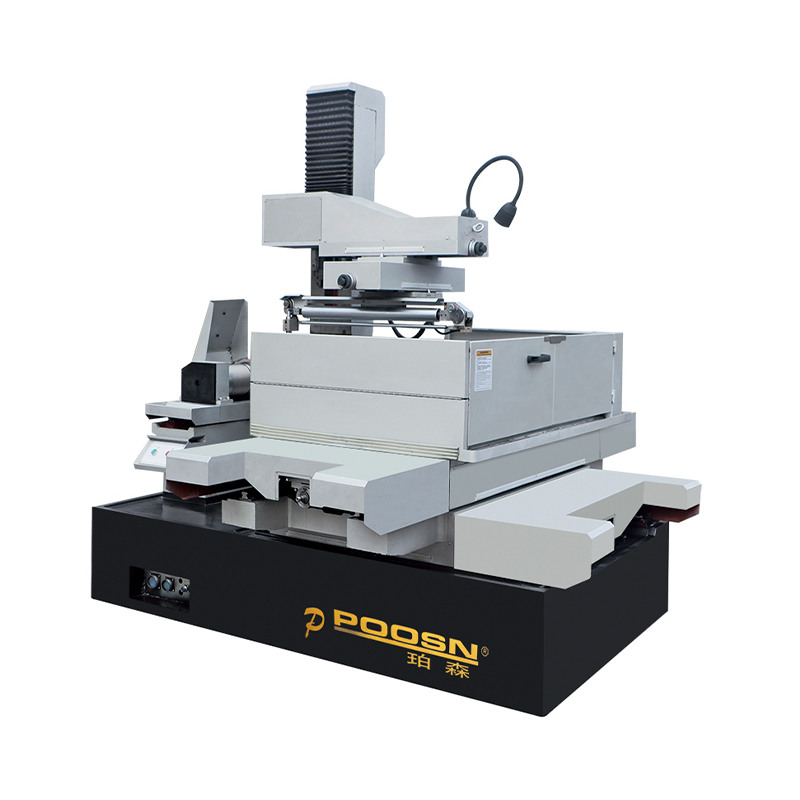
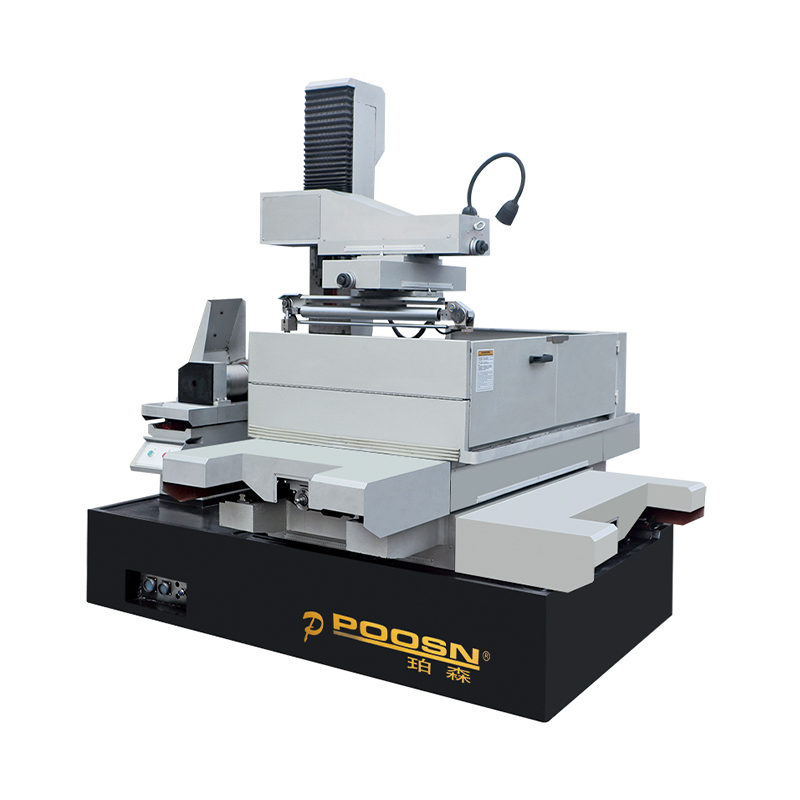
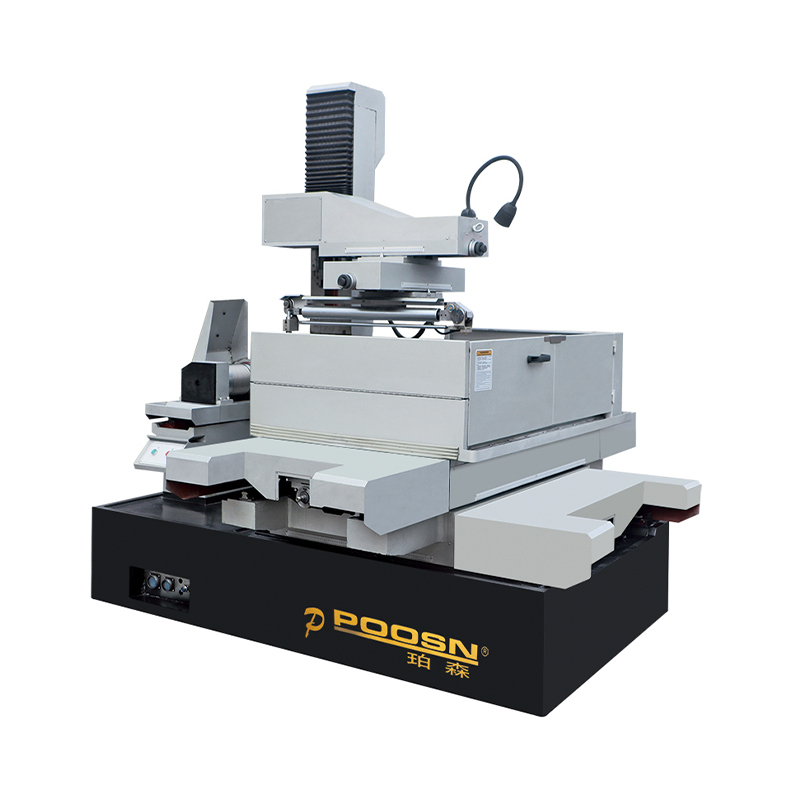
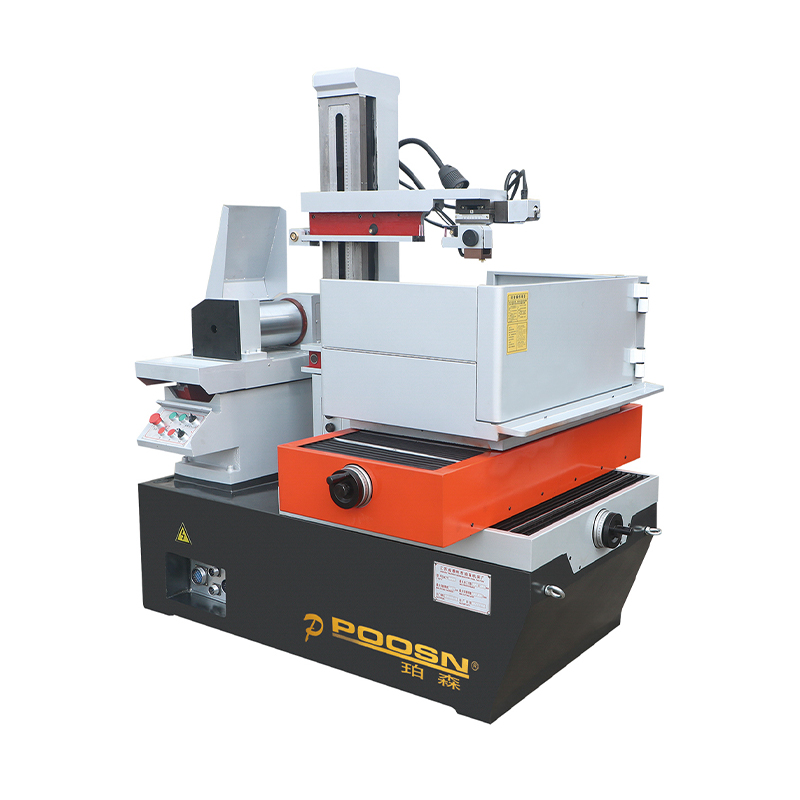
DK45BC CNC Medium-Speed Wire EDM Machine (400kg Load)
Content
- 1 Product Positioning and Main Applications
- 2 Core Advantages of the DK45BC
- 3 Mechanical Structure and Manufacturing Stability
- 4 Control System and Intelligent Machining Functions
- 5 Precision, Surface Quality, and Process Capability
- 6 Cooling, Filtration, and Environmental Performance
- 7 Manufacturing Processes and Quality Assurance
- 8 Configuration and Technical Specifications
- 9 Options and Customization
- 10 Model Selection within the Product Family
- 11 Operating Costs and Maintenance
- 12 Service, Training, and International Support
- 13 Recommended Production Workflow
- 14 Safety and Installation Considerations
- 15 Why the DK45BC Is a Competitive Choice
- 16 Q&A: Frequently Asked Questions
- 16.1 Q1: What type of production is the DK45BC best suited for?
- 16.2 Q2: What is the maximum workpiece weight?
- 16.3 Q3: Can the DK45BC cut workpieces 450 mm thick?
- 16.4 Q4: What materials can the machine process?
- 16.5 Q5: Can the DK45BC perform taper cutting?
- 16.6 Q6: What is the difference between the DK45BC and a high-speed DK-77 machine?
- 16.7 Q7: Is a linear scale necessary?
- 16.8 Q8: Does the machine require a climate-controlled room?
- 16.9 Q9: How many cutting passes can be used?
- 16.10 Q10: What is the expected surface roughness?
- 16.11 Q11: Is automatic wire threading available?
- 16.12 Q12: What information should be provided when requesting a quotation?
- 16.13 Q13: What after-sales support is available?
- 16.14 Q14: How is the DK45BC shipped?
- 17 Conclusion
- 18 References
- 19 Product: DK45BC CNC Medium-Speed Wire EDM Machine (400kg Load)
Product Positioning and Main Applications
The DK45BC is a high-medium-speed wire-cut EDM machine intended for production environments that need more capacity than a small-format machine can provide. It is particularly suitable for workpieces that are too large or heavy for entry-level equipment but do not justify the footprint and investment of an extra-large wire EDM system.
The machine is designed around a 650 × 926 mm worktable and provides an X/Y travel of 450 × 600 mm. Its processing slot measures approximately 650 × 970 mm, while the maximum cutting thickness is rated at 450 mm. A maximum worktable load of 400 kg allows users to mount substantial molds, plates, dies, and mechanical components while retaining adequate capacity for fixtures and workholding accessories.
Typical applications include:
• Precision mold inserts and mold plates
• Punches, dies, and forming tools
• Automotive stamping and tooling components
• Hardened mechanical parts
• Aerospace and high-performance alloy components
• Carbide cutting-tool blanks and wear-resistant components
• Prototype parts and medium-batch production
• Complex profiles, internal cavities, narrow slots, and contoured openings
The DK45BC can process any electrically conductive material within the machine’s operating capability. Common materials include tool steels, stainless steels, copper alloys, aluminum alloys, cemented carbide, titanium alloys, and high-temperature alloys. Because the process does not depend on conventional cutting-edge hardness, the machine can cut hardened materials that may be costly or time-consuming to mill.
Core Advantages of the DK45BC
Large Work Area with 400 kg Load Capacity
One of the most important advantages of the DK45BC is its capacity for medium-to-large workpieces. A 400 kg maximum load provides greater flexibility than compact models designed for small parts and light tooling. This is valuable when the workpiece itself is heavy, when a robust fixture is required, or when multiple components must be mounted in one setup.
The larger table also reduces the need for repeated repositioning. Fewer setups can improve dimensional consistency because the workpiece remains in a stable reference position during machining. It can also reduce setup time in medium-batch production, especially when several components share similar profiles or when a family of parts is processed together.
450 mm Maximum Cutting Thickness
The rated maximum cutting thickness of 450 mm makes the DK45BC appropriate for thick mold plates, heavy tooling, and deep-profile components. Thick workpieces demand careful control of flushing, wire tension, discharge energy, and machining speed. The DK45BC is designed to support these requirements through a regulated wire-feed system and a cooling and filtration circulation system.
Actual cutting performance depends on material type, material thickness, electrical conductivity, workpiece geometry, flushing conditions, wire condition, and the selected machining parameters. For particularly thick or heavy workpieces exceeding the practical range of the DK45BC, the DK50BC or DK60BC models may be more appropriate because they provide larger travel and higher load capacity.
High Cutting Efficiency
The maximum cutting efficiency is specified at approximately 10,000 to 16,000 mm²/h, depending on the selected control cabinet and process conditions. This range supports medium-batch production and allows manufacturers to increase output without moving directly to a high-cost imported low-speed wire EDM machine.
Cutting efficiency should always be evaluated together with accuracy and surface finish. A roughing pass may be programmed for higher material removal, while finishing passes use adjusted discharge parameters and wire-feed conditions to improve the final surface. This approach allows the DK45BC to combine productive rough cutting with controlled finishing work.
Multi-Pass Machining Capability
The medium-speed architecture of the DK45BC supports multi-pass cutting. In a typical process, the first pass removes the majority of the material, while subsequent passes correct the profile and improve surface quality. Multi-pass machining is especially useful for precision molds, punches, dies, and components requiring a fine, uniform finish.
Compared with a conventional high-speed wire-cut machine used primarily for single-pass roughing, the DK45BC offers greater flexibility when the customer requires tighter geometry, improved surface texture, or reduced secondary finishing. The number of passes and their parameters can be selected according to material, thickness, geometry, tolerance, and production objectives.
Four-Axis Linkage and Taper Cutting
The machine uses X, Y, U, and V four-axis linkage. The X and Y axes control the primary worktable movement, while the U and V axes support taper cutting. The standard taper device provides a U/V travel of 60 × 60 mm and a maximum cutting taper of approximately ±6° over 80 mm, according to the standard machine specification.
Taper cutting is useful for punches, dies, extrusion components, slanted cavities, and parts that require a controlled angular profile. For applications needing substantially larger taper angles, a customized large-taper configuration may be considered. Such applications should be reviewed by the engineering team because workpiece thickness, guide structure, wire travel, flushing, and profile accuracy all influence the final result.
Mechanical Structure and Manufacturing Stability
Rigid Cast-Iron Foundation
Wire EDM accuracy depends not only on the control system but also on the mechanical stability of the machine. The DK45BC uses a robust cast-iron machine base and structural components designed to resist deformation during long machining cycles. A stable foundation helps reduce vibration, maintain axis geometry, and support reliable wire positioning.
The supplied technical description emphasizes aging treatment of the cast-iron base to reduce internal stress. Stress relief is important because residual stress can gradually change the geometry of a machine structure, particularly when temperature and workload vary. A properly stabilized structure gives the guideways, ball screws, and working table a more consistent reference during operation.
Linear Guide Support
High-precision linear guide rails are provided as standard. Compared with sliding guide structures, linear guides generally offer lower friction, smoother motion, and improved repeatability when correctly installed and maintained. They also support faster response from the drive system and help reduce stick-slip behavior during fine movements.
The use of linear guides is one of the features that distinguishes the DK-BC series from basic high-speed wire EDM designs that rely on sliding guide systems. For mold work and finishing passes, smooth low-speed movement is important because small changes in axis motion can influence the accuracy of the final contour.
Controlled Wire Movement
The wire-feed system supports a wire speed from approximately 1 to 11 m/s through frequency control. The maximum wire drum travel is approximately 180 mm, and the standard electrode wire diameter is 0.18 mm with a wire-guiding device. Maximum wire storage length is approximately 350 m.
Variable wire speed allows the machine to respond to different stages of the machining process. Higher speed can support productive rough cutting, while reduced and more stable wire movement can help control vibration during finishing. The exact settings depend on workpiece thickness, material, flushing, discharge energy, and the desired surface condition.
The wire system also includes an easy-threading waterproof guide-wheel arrangement. Stable wire guidance is essential because wire deflection, vibration, contamination, or improper tension can affect taper accuracy, straightness, corner quality, and the risk of wire breakage.
Worktable and Processing Tank Design
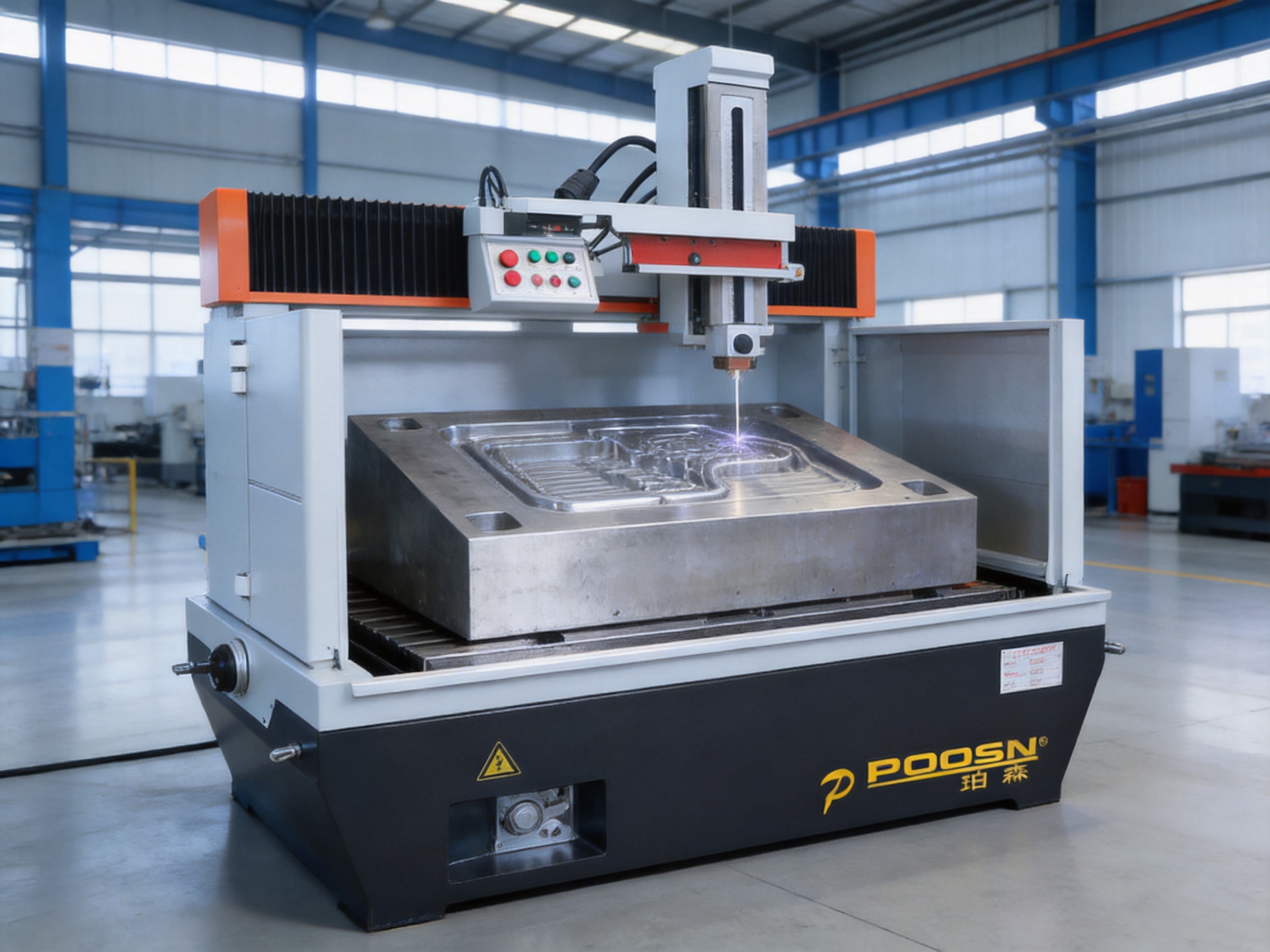
The DK45BC has a worktable size of 650 × 926 mm and a processing slot size of 650 × 970 mm. The worktable is designed for the mounting of medium-sized components and fixtures while allowing the wire frame to access the programmed cutting area.
A waterproof working area helps contain the dielectric fluid and cutting debris. The standard configuration includes an eco-friendly waterproof cover, while a high-pressure water tank is available as an option. Effective fluid circulation is particularly important for thick workpieces because debris must be removed from the cutting gap to prevent unstable discharges and excessive wire wear.
Control System and Intelligent Machining Functions
X8 and AUTOCUT Programming Platform
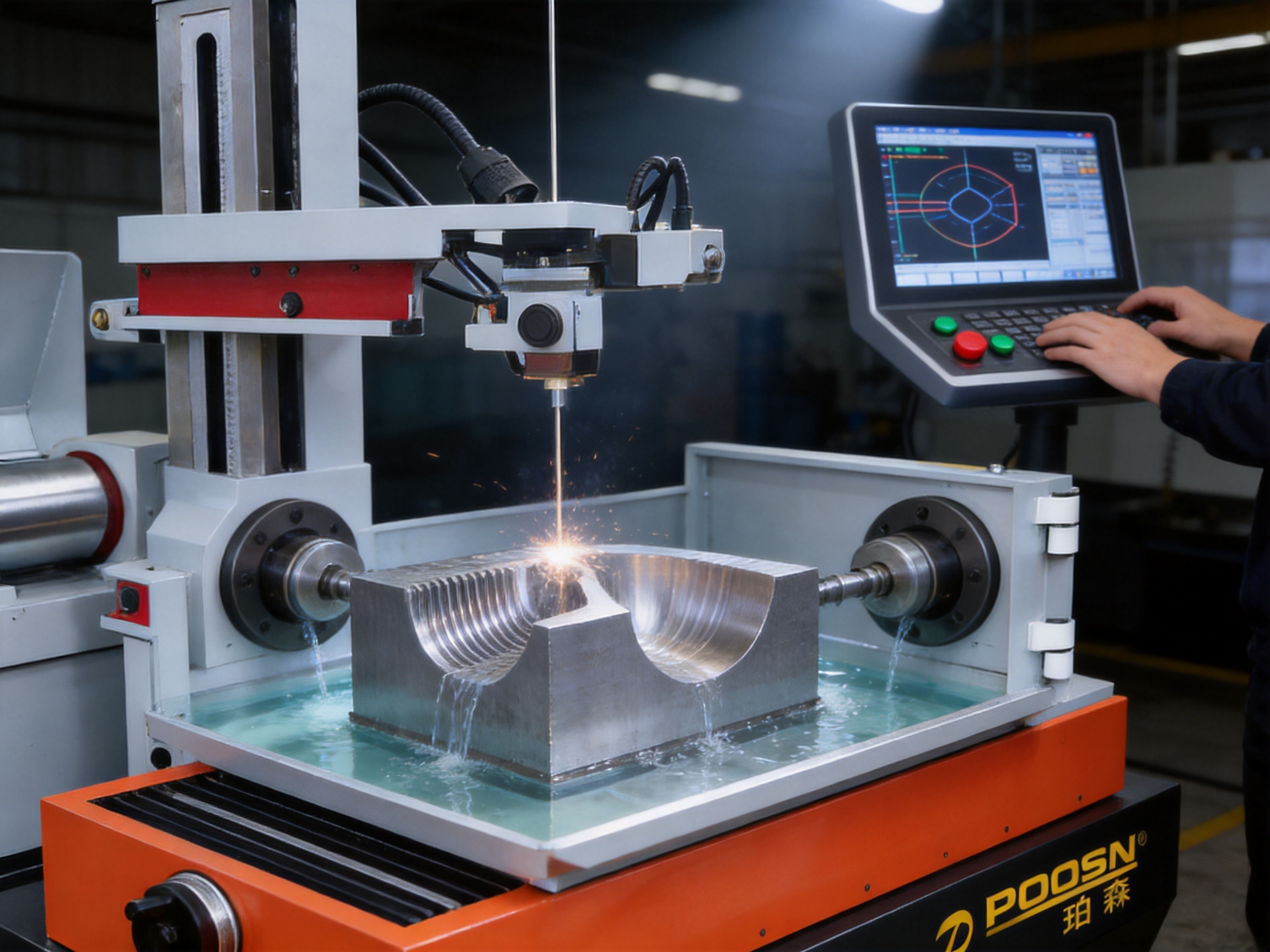
The DK45BC is equipped with an X8/AUTOCUT programming control system. The control platform is intended to simplify machine operation, support four-axis linkage, and provide access to cutting parameters and multi-pass machining routines.
Graphical programming and parameter-based operation can reduce the amount of manual code preparation required for common profiles. Depending on the configuration and software package, users can import or prepare geometric information, define cutting paths, set compensation values, and organize roughing and finishing passes through the control interface.
The system is designed for operators with basic CNC experience. Standard operating procedures generally include workpiece alignment, edge finding, coordinate setting, wire threading, parameter selection, simulation or path checking, and machining monitoring. Training and an English operation manual can help operators become familiar with the machine and reduce setup errors.
Adaptive Discharge Control
Wire EDM is sensitive to changes in the discharge gap. If the gap becomes contaminated or unstable, the machine may experience short circuits, wire breakage, poor surface quality, or dimensional deviations. The DK45BC control architecture is designed to monitor discharge conditions and adjust machining behavior to help maintain a stable cutting process.
Adaptive control is particularly beneficial when the wire enters corners, narrow sections, thick materials, or areas where flushing conditions change. By regulating feed and discharge behavior, the system can reduce the likelihood of unstable cutting. It cannot eliminate the need for correct setup and maintenance, but it gives the operator a more responsive process-control foundation.
Programmed Multi-Pass Profiles
Multi-pass cutting is more effective when the control system can manage the relationship between roughing, semi-finishing, and finishing operations. The DK45BC supports process planning in which different passes use different discharge energy, wire speed, offset, and feed settings.
This capability offers several benefits:
• Improved dimensional control after the finishing pass
• Reduced need for manual rework
• More consistent surface quality between parts
• Better adaptability to different materials and thicknesses
• Easier standardization of repeat production jobs
Optional Linear Scale Feedback
Linear scales are available as an optional upgrade. A scale-feedback system directly measures axis position and can help compensate for errors associated with screw pitch, thermal changes, mechanical transmission, and positioning deviation. This option is valuable for customers producing precision molds or components with demanding repeatability requirements.
The published DK-BC information states a linear positioning accuracy of approximately 0.002 mm for the series under specified conditions and identifies glass-scale feedback as an option for applications requiring tighter control. Actual performance should be verified through a formal acceptance test using the customer’s material, thickness, geometry, and specified inspection standard.
Precision, Surface Quality, and Process Capability
The standard machine performance is specified according to GB/T 7926-2015, with an optimal surface roughness of up to Ra ≤ 2.5 μm under the listed general configuration. Additional process information identifies surface finishes as low as approximately Ra 0.8 μm for selected DK-BC applications using suitable multi-pass parameters and machine configurations.
These values should not be interpreted as guaranteed results for every material and geometry. Surface roughness depends on many variables, including:
• Material composition and hardness
• Workpiece thickness
• Cutting height and flushing conditions
• Roughing and finishing parameters
• Wire quality and wire tension
• Guide-wheel and nozzle condition
• Dielectric-water conductivity and filtration
• Corner geometry and programmed compensation
• Temperature stability and machine alignment
For this reason, a proper application evaluation is recommended when a customer has a critical tolerance or surface-finish requirement. The machine’s mechanical structure and multi-pass control provide the foundation, while process optimization determines the final result.
Comparison with High-Speed Wire EDM
Traditional high-speed wire EDM machines are often selected for cost-effective rough cutting, high-volume blanking, and applications where the surface finish requirement is moderate. They typically use a continuously circulating molybdenum wire and are designed for dependable general-purpose production.
The DK45BC offers a different balance. Its linear guide system, variable wire-feed control, multi-pass capability, four-axis linkage, and larger worktable make it more suitable for precision finishing and complex profiles. The DK-BC series is specified for a surface finish range of approximately Ra 0.8–1.2 μm in suitable applications, while the DK-77 high-speed series is described as typically producing approximately Ra 1.6–2.5 μm.
In practical terms, a manufacturer should select the DK45BC when the process requires more than a single rough cut. It is especially attractive when the user wants to reduce polishing, grinding, or secondary correction after wire cutting. A high-speed model may remain preferable when the main objective is economical rough blanking with lower initial equipment complexity.
Comparison with Imported Low-Speed Wire EDM
Imported low-speed wire EDM machines are recognized for sophisticated automation, highly refined discharge systems, and excellent process control. However, they may involve a considerably higher purchase price, more expensive consumables, strict environmental requirements, and higher service costs.
The DK45BC is positioned as a cost-effective alternative for manufacturers that need precision medium-speed wire cutting without the full investment level associated with premium imported systems. Its consumables, guide components, wire, and maintenance parts are designed to be practical for everyday factory use. The machine also operates in a general workshop environment, although temperature control remains recommended for the most demanding micron-level work.
The comparison should be based on the complete production cost rather than purchase price alone. Factors such as cutting time, number of passes, wire consumption, operator training, spare-parts availability, maintenance response, energy use, and required secondary processing all contribute to total cost of ownership.
Cooling, Filtration, and Environmental Performance
Stable dielectric water is fundamental to wire EDM. The working fluid must cool the cutting zone, carry away eroded particles, and support consistent electrical discharge conditions. Contaminated or poorly controlled water can lead to unstable machining, wire breakage, poor surface quality, and premature wear of guide components.
The DK45BC uses a cooling and filtration circulation system designed to maintain suitable fluid conditions. A high-pressure water tank is available as an option for applications that require stronger flushing. Thick workpieces and deep cutting sections benefit particularly from effective upper and lower flushing because debris has a longer path to leave the kerf.
Filtration also contributes to lower operating variation. When particles accumulate in the dielectric circuit, the discharge gap can become less predictable. Regular inspection of filters, pumps, seals, water conductivity, and resin condition is therefore an important part of machine ownership.
The supplied operating information recommends replacing water-based dielectric fluid approximately every two to three months, with the exact interval depending on workload and fluid condition. Ion-exchange resin may require replacement approximately every three to six months. These are general guidelines rather than fixed rules; conductivity and actual fluid quality should determine the maintenance schedule.
Manufacturing Processes and Quality Assurance
Engineering and Product Development
Taizhou Xinchengyang Machinery Manufacturing Co., Ltd. has specialized in electrical discharge wire cutting since 1999 and developed the POOSN brand in 2003. The company manufactures medium-speed, high-speed, and large-taper wire-cut EDM equipment for domestic and international users.
The company’s product development approach combines mechanical design, electrical control, process research, and application feedback. Experience from customers in Southeast Asia, West Asia, Europe, the Americas, and other markets provides practical information about different materials, production environments, power conditions, and service requirements.
This market feedback supports ongoing improvements to machine structure, electrical systems, control functions, and customer support procedures. The result is a product range intended not only to meet a basic machine specification but also to address the practical requirements of daily production.
Precision Machining and Component Preparation
The manufacturing quality of a wire EDM machine depends heavily on the accuracy of its own structural and transmission components. Guideway mounting surfaces, screw supports, table assemblies, wire-frame components, and water-system interfaces must be produced and assembled carefully.
Precision machining of these parts establishes the geometric foundation for the finished machine. Correct parallelism, perpendicularity, flatness, and alignment are necessary to achieve repeatable workpiece results. Assembly procedures must then preserve those relationships while the machine is fitted with guide rails, drive components, wire guides, electrical systems, and control cabinets.
A strong manufacturer also needs comprehensive testing equipment. According to the company information, each machine tool undergoes positioning-accuracy testing before delivery. Such testing supports the verification of axis movement, repeatability, geometric behavior, and overall machine condition.
Stress Relief and Structural Verification
Cast-iron components are subject to internal stress created during casting and machining. Extended aging treatment helps reduce the risk of later movement. The company describes the DK45BC base as receiving aging treatment intended to stabilize the structure before final assembly.
Structural stability is especially important for a machine intended to cut thick and heavy parts. The larger the workpiece and the longer the machining cycle, the more important it becomes to maintain consistent mechanical relationships between the table, wire frame, guide rails, and workpiece.
Factory Testing and Test Cutting
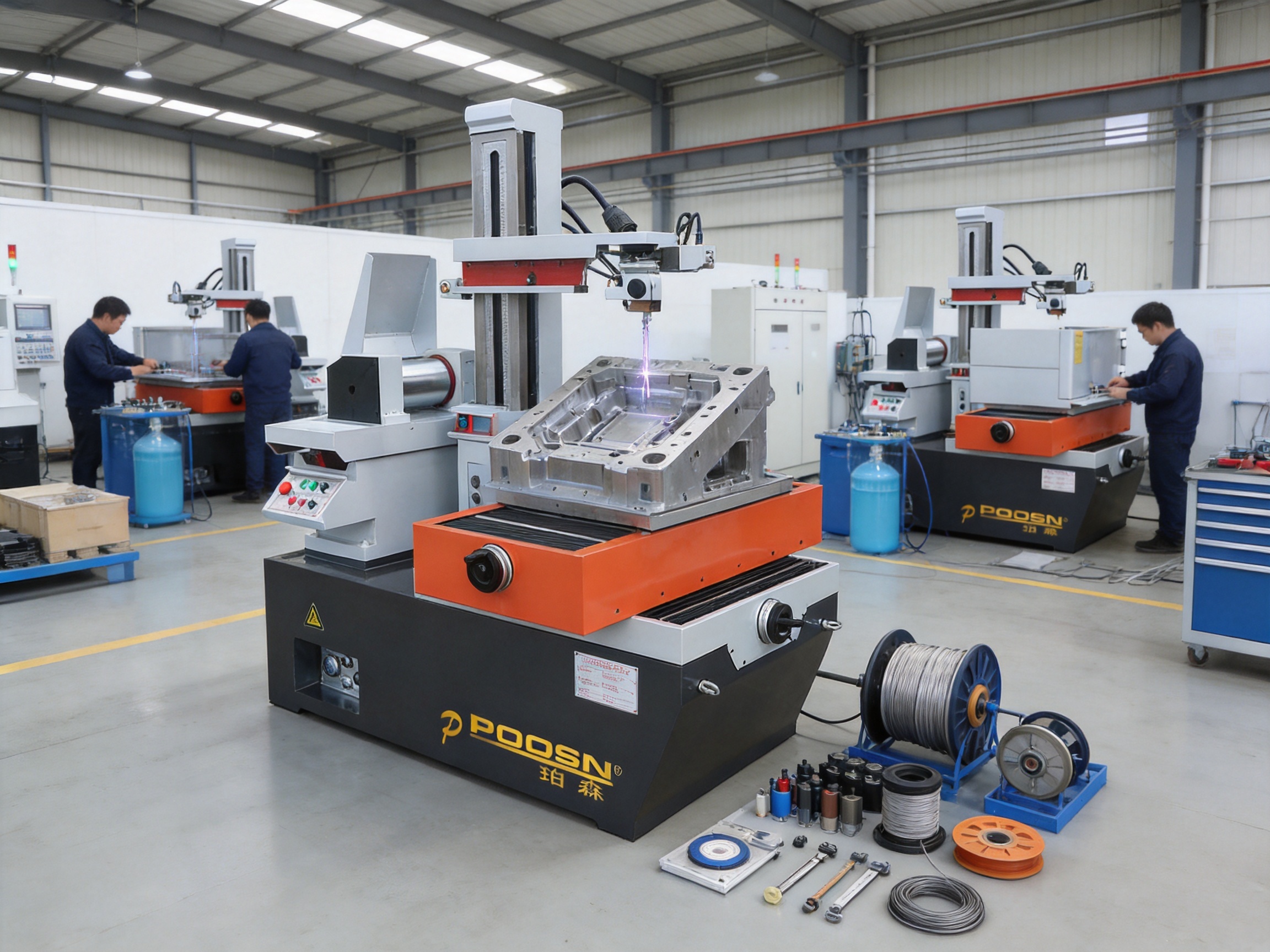
Before shipment, the DK45BC is assembled, calibrated, and test-cut at the factory. Test cutting provides a practical confirmation that the machine can complete a representative machining cycle and that the wire-feed system, water circulation, control functions, and axis movement operate together.
Factory verification may include dimensional checks, positioning tests, geometric accuracy inspection, electrical safety checks, water-system inspection, wire-threading tests, and sample cutting. Shipping preparation uses anti-vibration and moisture-resistant protection to help preserve the machine’s calibrated condition during transportation.
After arrival, installation normally requires leveling, connection to the appropriate power supply, connection of the working-fluid system, and final commissioning. The customer should still complete an acceptance test under local operating conditions before beginning full production.
Configuration and Technical Specifications
| Item | DK45BC Specification |
| Machine type | High-medium-speed CNC wire-cut EDM machine |
| Worktable size | 650 × 926 mm |
| X/Y travel | 450 × 600 mm |
| Processing slot size | 650 × 970 mm |
| Maximum cutting thickness | 450 mm |
| Maximum worktable load | 400 kg |
| U/V travel | 60 × 60 mm |
| Maximum taper | Approximately ±6° / 80 mm |
| Electrode wire diameter | 0.18 mm with guide device |
| Wire-feed speed | 1–11 m/s, frequency controlled |
| Maximum wire storage length | Approximately 350 m |
| Maximum cutting efficiency | 10,000–16,000 mm²/h |
| Optimal surface roughness | Ra ≤ 2.5 μm under listed standard conditions |
| NC-controlled axes | X, Y, U, and V four-axis linkage |
| Worktable drive | Standard X/Y stepper drives; AC servo drives optional |
| Taper-device drive | U/V three-phase stepper drives |
| Programming system | X8/AUTOCUT |
| Control cabinet | Standard ZHZK-03; ZHZ-09G optional |
| Maximum processing current | 6 A |
| Electrical capacity | 2.5 KVA |
| Power supply | 3N 380 V ±10% |
| Machine weight | Approximately 1,400 kg |
| Overall dimensions | Approximately 1,915 × 1,655 × 1,830 mm |
Options and Customization
The standard DK45BC configuration can be adapted for different production requirements. Available options include a high-pressure water tank, linear scale feedback, AC servo drives, and an upgraded control cabinet. These options allow customers to select the appropriate balance between investment, precision, automation, and cutting performance.
For special applications, customization may include:
• Extended X/Y travel
• Larger worktable dimensions
• Increased taper capability
• Automatic wire threading
• Closed-loop glass-scale feedback
• Upgraded CNC or control cabinet functions
• C-axis rotary-table integration
• CE or UL documentation and certification packages
Customers should provide the manufacturer with workpiece dimensions, weight, material, thickness, tolerance, taper requirements, expected production volume, and desired surface finish. This information allows the engineering team to recommend the correct configuration rather than simply selecting a machine based on travel size.
For example, a customer cutting medium-sized hardened mold plates may benefit from the standard DK45BC with a high-pressure water system. A customer producing extremely tight-tolerance components may require linear-scale feedback, a temperature-controlled room, and a defined multi-pass process. A customer processing components above 400 mm thickness may need to evaluate the larger DK50BC or DK60BC models.
Model Selection within the Product Family
| Model | X/Y Travel | Maximum Thickness | Maximum Load | Typical Application |
| DK35BC | 350 × 450 mm | 450 mm | 300 kg | Small precision parts, dies, electrodes, and compact molds |
| DK45BC | 450 × 600 mm | 450 mm | 400 kg | Medium molds, automotive tooling, and heavy medium-sized workpieces |
| DK50BC | 500 × 700 mm | 650 mm | 600 kg | Large molds, thick workpieces, and higher-capacity production |
| DK60BC | 600 × 800 mm | 800 mm | 800 kg | Oversized molds and heavy industrial components |
The DK45BC is generally the most balanced choice for customers who need a larger workbench and higher load capacity than the DK35BC but do not require the extra-large capacity of the DK50BC or DK60BC. The correct choice should be based on the largest expected workpiece, not merely the average part.
Manufacturers should leave sufficient space for fixtures, workholding, wire access, flushing, and safe loading. A part that technically fits within the travel range may still be unsuitable if the fixture blocks the wire path or if the combined part-and-fixture weight approaches the machine’s maximum load.
Operating Costs and Maintenance
The DK45BC is intended to provide practical operating costs for production workshops. Its consumables include molybdenum wire, guide wheels, guide nozzles, dielectric fluid, filters, and ion-exchange resin. Consumable life varies according to cutting hours, material, thickness, power settings, flushing conditions, and maintenance quality.
| Consumable | Typical Service Interval | Maintenance Consideration |
| 0.18 mm molybdenum wire | Approximately 40–80 continuous hours | Inspect for wear, oxidation, tension variation, and surface damage |
| Guide wheels | Approximately 6–12 months | Replace when wear affects wire stability or dimensional accuracy |
| Guide nozzles | Approximately 3–6 months | Inspect for wear, blockage, and misalignment |
| Water-based dielectric fluid | Approximately every 2–3 months | Check conductivity, contamination, odor, and filtration performance |
| Ion-exchange resin | Approximately every 3–6 months | Replace according to water-quality readings and operating condition |
Routine maintenance should include cleaning the processing tank, inspecting wire guides, checking pump operation, verifying water level, measuring dielectric conductivity, removing accumulated debris, and confirming that the wire path is correctly aligned. Preventive maintenance is less expensive than repairing a machine after a dimensional problem or wire breakage event has damaged a critical component.
One of the product’s competitive strengths is the availability of commonly used consumables and replacement components at relatively manageable cost. This can be particularly important for manufacturers operating in regions where imported parts require long lead times or expensive international shipping.
Service, Training, and International Support
Equipment performance depends on more than hardware. Installation, process training, parameter selection, maintenance guidance, and spare-parts response all influence the useful life of a wire EDM machine. Taizhou Xinchengyang Machinery Manufacturing Co., Ltd. provides technical support intended to maintain equipment stability throughout its service life.
The company’s service approach includes factory commissioning, remote technical assistance, operating guidance, process-parameter support, spare-parts dispatch, and long-term maintenance communication. Customers can receive assistance through remote video support, telephone communication, and online messaging platforms.
Process parameter support is especially valuable when a customer begins cutting a new material. Tool steel, stainless steel, carbide, aluminum, titanium, and nickel-based alloys each respond differently to discharge energy and flushing. A parameter library can shorten trial production and help operators avoid inefficient experimentation.
The standard warranty is described as 12 months from the shipment date, with remote technical support available throughout the machine’s service life. Critical spare parts may be dispatched by express courier, subject to availability and destination. Customers should confirm warranty coverage, installation responsibilities, training scope, and spare-parts terms in the final commercial contract.
Recommended Production Workflow
A reliable DK45BC process begins before the workpiece is placed on the table. The operator should verify material conductivity, thickness, weight, drawing requirements, coordinate references, taper information, and the desired finish. The workholding method must support the workpiece without obstructing the wire or flushing path.
The recommended general workflow is as follows:
1. Inspect the machine, working fluid, wire path, guide wheels, nozzles, and safety systems.
2. Confirm that the workpiece weight and dimensions are within the machine’s capability.
3. Mount and secure the workpiece using a stable, electrically suitable fixture.
4. Align the workpiece and establish the machine coordinate system.
5. Thread the wire and verify correct positioning through the upper and lower guides.
6. Load or create the cutting program and verify the contour, offset, taper, and cutting direction.
7. Select roughing and finishing parameters according to material and thickness.
8. Check dielectric flow and flushing coverage before starting the discharge cycle.
9. Monitor wire tension, discharge stability, water condition, and machining progress.
10. Inspect the first part and adjust parameters before beginning repeated production.
This workflow helps reduce avoidable errors. It also creates a repeatable process that can be documented and transferred between operators. For high-value molds or difficult materials, a trial cut on a representative sample may be appropriate before machining the final workpiece.
Safety and Installation Considerations
The DK45BC uses electrical power, moving machinery, a water-based working system, and a continuously moving electrode wire. Installation and operation should therefore be performed by trained personnel in accordance with applicable safety regulations.
The machine requires a suitable foundation, adequate floor loading, sufficient access for installation and maintenance, proper grounding, and a stable three-phase power supply. The listed power requirement is 3N 380 V ±10%, but the customer should verify local electrical compatibility before ordering.
Operators should avoid contact with the wire during operation, keep covers and guards in place, and follow lockout procedures during maintenance. Water leakage, damaged cables, abnormal noise, excessive vibration, or unstable discharge should be investigated before production continues.
Although the DK45BC is designed for general workshop conditions from approximately 5°C to 40°C, environmental stability remains important for precision work. Temperature changes can affect machine structure, workpiece dimensions, dielectric conditions, and measurement results. For tolerances below approximately ±3 μm, a temperature-controlled room and optional scale feedback are recommended.
Why the DK45BC Is a Competitive Choice
The DK45BC combines several advantages that are not always available in one medium-format machine. It offers a larger table and 400 kg load capacity, while maintaining the flexibility of a medium-speed process. It supports thick cutting up to 450 mm, four-axis taper machining, variable wire speed, multi-pass finishing, and optional feedback upgrades.
Against basic high-speed wire EDM machines, it offers a more suitable platform for finishing, complex contours, and improved surface quality. Against premium imported low-speed systems, it offers a more accessible purchase and maintenance model while retaining important capabilities such as multi-pass machining and process control.
Its strongest competitive position is therefore not based on one isolated specification. It is based on the combination of:
• Medium-to-large workpiece capacity
• Heavy-duty 400 kg table loading
• 450 mm cutting thickness
• Linear guide support
• Four-axis linkage and taper cutting
• Variable-frequency wire-feed control
• Multi-pass finishing capability
• Optional linear scales and servo drives
• Practical consumable and maintenance costs
• Factory testing and international technical support
For manufacturers seeking a machine that can support both productive roughing and precision finishing, the DK45BC provides a well-balanced solution. It is particularly attractive for companies expanding from small parts into medium-sized molds, automotive tooling, or heavier components.
Q&A: Frequently Asked Questions
Q1: What type of production is the DK45BC best suited for?
The machine is best suited for medium-sized molds, mechanical components, automotive tooling, hardened parts, and medium-batch production. It is a good choice when the customer needs a larger table, greater load capacity, and better finishing capability than a compact machine can provide.
Q2: What is the maximum workpiece weight?
The maximum worktable load is 400 kg. This figure includes the workpiece and should be considered together with the fixture, support tooling, and loading method. Heavy workpieces should be distributed properly on the table to avoid unstable loading.
Q3: Can the DK45BC cut workpieces 450 mm thick?
The maximum rated cutting thickness is 450 mm. Actual results depend on material, geometry, flushing, wire condition, and machining parameters. For frequent workpieces above 400 mm thickness, the DK50BC or DK60BC may provide a more comfortable operating margin.
Q4: What materials can the machine process?
The DK45BC can process electrically conductive materials, including tool steels, stainless steels, cemented carbide, titanium alloys, copper, aluminum, nickel-based alloys, and other conductive metals. Electrical conductivity, thickness, melting behavior, and process parameters influence cutting speed and finish.
Q5: Can the DK45BC perform taper cutting?
Yes. The standard U/V taper device provides approximately 60 × 60 mm travel and a maximum taper of about ±6° over 80 mm. Larger taper angles may be possible with a customized large-taper configuration after engineering evaluation.
Q6: What is the difference between the DK45BC and a high-speed DK-77 machine?
The DK45BC uses linear guide support, variable wire-feed control, and multi-pass cutting for applications emphasizing precision and surface finish. A DK-77 high-speed model is generally more appropriate for economical rough cutting, blanking, and applications where a single-pass process is sufficient.
Q7: Is a linear scale necessary?
It is not necessary for every application. The standard configuration is suitable for many mold and mechanical-component jobs. Linear-scale feedback is recommended when the customer requires tighter positioning control, improved repeatability, or compensation for thermal and transmission errors.
Q8: Does the machine require a climate-controlled room?
The machine is designed for general workshop environments from approximately 5°C to 40°C. However, temperature control is recommended for high-precision work, especially when tolerances approach or exceed the micron level. The machine should also be protected from severe temperature changes, direct sunlight, and excessive humidity.
Q9: How many cutting passes can be used?
The DK-BC series supports multi-pass machining, commonly organized into roughing, semi-finishing, and finishing stages. The actual number of passes depends on the required tolerance, surface finish, material, thickness, and production schedule.
Q10: What is the expected surface roughness?
The standard specification lists an optimal surface roughness of Ra ≤ 2.5 μm. Under suitable multi-pass conditions and selected configurations, finer finishes may be achieved. Final results must be confirmed through a sample test because material and process conditions strongly influence surface quality.
Q11: Is automatic wire threading available?
Automatic wire threading is available as a customization option for suitable applications. It can reduce operator intervention and support unattended or multi-cavity mold production. The customer should confirm compatibility with the required workpiece geometry and machine configuration.
Q12: What information should be provided when requesting a quotation?
The customer should provide maximum workpiece length, width, height, weight, material, required tolerance, surface-finish target, taper angle, expected production volume, local voltage, preferred control system, and any automation requirements. This information allows the manufacturer to recommend the correct model and options.
Q13: What after-sales support is available?
Support includes installation guidance, remote troubleshooting, operator training, process-parameter advice, spare-parts service, and long-term technical communication. The listed warranty period is 12 months from shipment, while customers should confirm detailed terms in their purchase agreement.
Q14: How is the DK45BC shipped?
The machine is shipped assembled, calibrated, and test-cut at the factory. Sea freight is commonly used for international delivery, while rail freight may be suitable for selected regions. After arrival, the machine normally requires leveling, power connection, working-fluid preparation, and final commissioning.
Conclusion
The DK45BC CNC Medium-Speed Wire EDM Machine is designed for manufacturers that need a practical combination of workpiece capacity, machining precision, production efficiency, and long-term serviceability. Its 450 × 600 mm X/Y travel, 400 kg load capacity, and 450 mm maximum cutting thickness make it suitable for a broad range of medium-sized and heavy workpieces.
Linear guide support, variable wire speed, four-axis linkage, multi-pass cutting, optional linear scales, and an X8/AUTOCUT control system give the machine capabilities beyond basic high-speed wire cutting. At the same time, its machine structure, filtration system, service model, and consumable strategy are intended to keep ownership practical for production workshops.
Taizhou Xinchengyang Machinery Manufacturing Co., Ltd. strengthens this product through long-term specialization in wire EDM, factory-based design and production, structural stabilization, precision testing, test cutting, customization, and international technical assistance. The result is a medium-speed wire EDM solution positioned between entry-level high-speed equipment and premium imported low-speed systems.
For mold shops, tooling manufacturers, automotive suppliers, aerospace component producers, and general precision-machining companies, the DK45BC can provide a dependable platform for thick-material cutting, complex profiles, taper work, and multi-pass finishing. Its final performance will depend on correct model selection, proper installation, suitable parameters, disciplined maintenance, and verification against the customer’s actual production requirements.
References
1. Technical specification data for the DK45BC and DK-BC series supplied by Taizhou Xinchengyang Machinery Manufacturing Co., Ltd.
2. GB/T 7926-2015, technical requirements and inspection principles for wire-cut electrical discharge machining equipment.
3. General principles of wire electrical discharge machining, including discharge-gap control, dielectric filtration, wire guidance, and multi-pass cutting.
4. Manufacturer’s operating and maintenance information for X8/AUTOCUT-controlled medium-speed wire EDM systems.
5. Manufacturer’s product information for PS-C, DK-BC, DK-77, and DKD wire-cut EDM machine families.
Product: DK45BC CNC Medium-Speed Wire EDM Machine (400kg Load)
-
Phone
+86-0523-86268788 +86-13815960366 +86-13912191163Email
[email protected]Address
No. 366, Yusheng Road Jiulong Town, Hailing District Taizhou City, China
Copyright © Taizhou Xinchengyang Machinery Manufacturing Co., Ltd. All Rights Reserved.
Custom edm machine for sale
wholesale edm machine manufacturers
