

 English
 русский
 عربى
عربى

Zhou Meiling — Technical Sales Consultant
Home / Author / Zhou Meiling — Technical Sales Consultant / DK45D CNC Large-Taper Wire-Cut EDM Machine for Precision Mold and Complex Component Machining
DK45D CNC Large-Taper Wire-Cut EDM Machine for Precision Mold and Complex Component Machining
2026-08-25
Precision machining increasingly requires more than conventional two-dimensional cutting. Modern molds, aerospace components, automotive parts, and specialized mechanical elements often contain inclined surfaces, variable profiles, deep sections, and complex contours that must be produced with stable dimensional accuracy. When these requirements are combined with heavy workpieces and demanding production schedules, a wire-cut electrical discharge machining machine must provide large taper capability, reliable axis coordination, rigid mechanical construction, efficient flushing, and intuitive control.
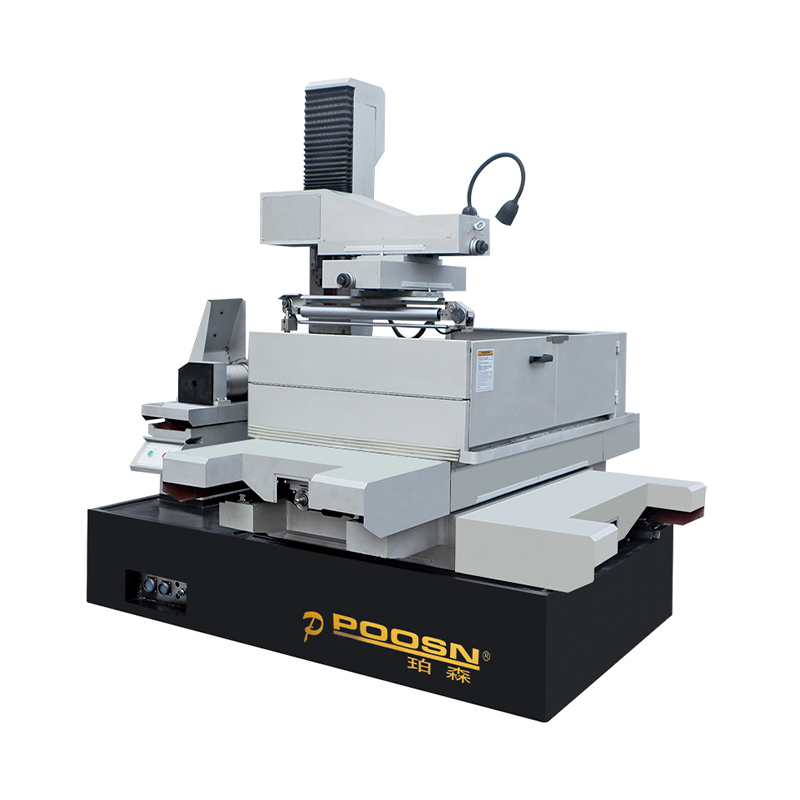
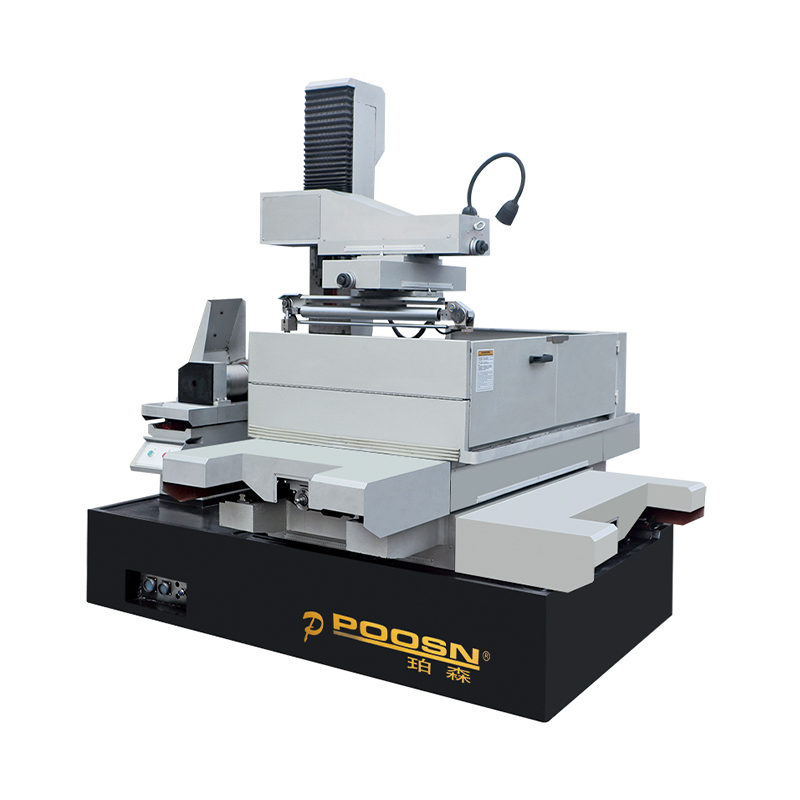
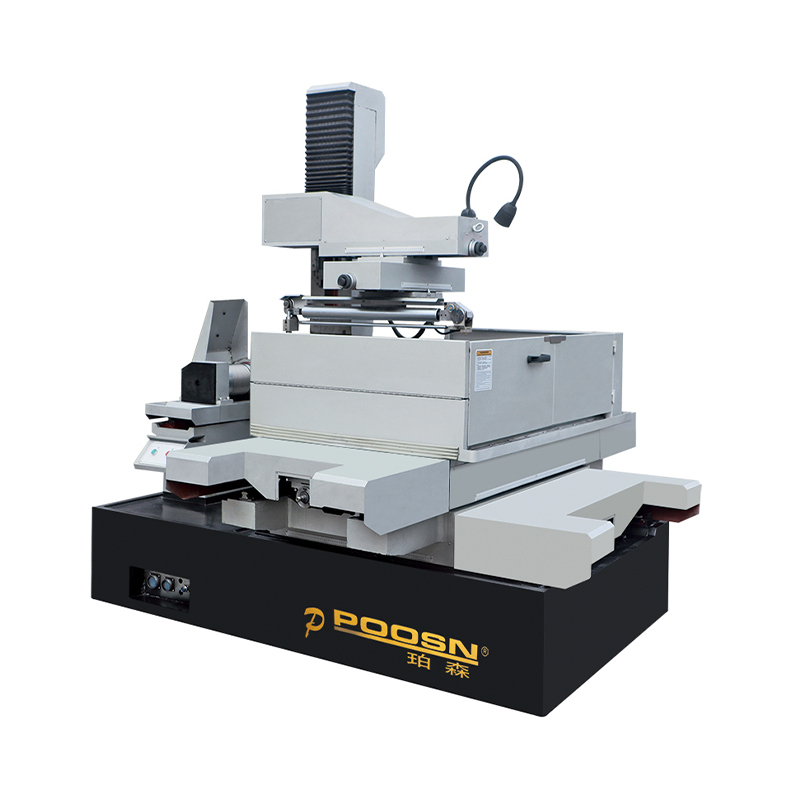
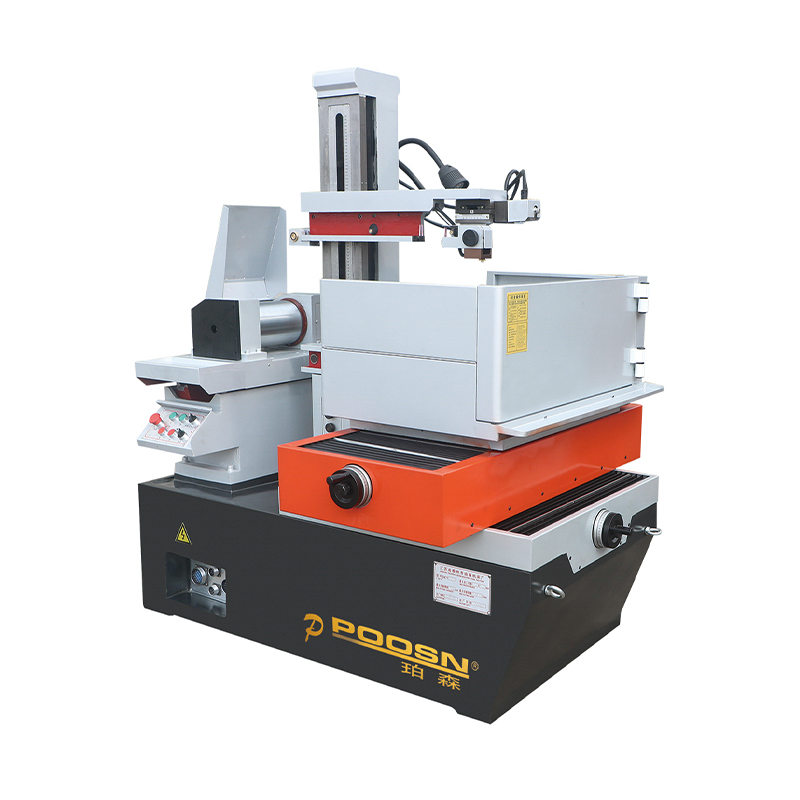
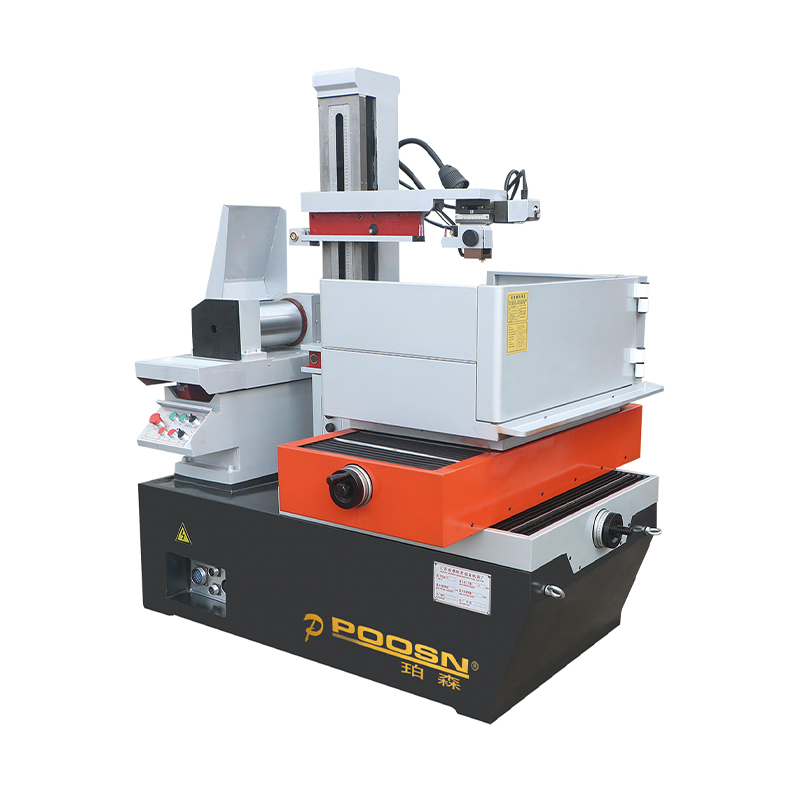
The DK45D CNC Large-Taper Wire-Cut EDM Machine is designed for this class of application. It combines four-axis X, Y, U, and V linkage with a maximum cutting thickness of 450 mm, a maximum cutting taper of ±30° per 40 mm, and a maximum worktable load of 400 kg. Its configuration is intended for medium-sized workpieces, precision molds, large-angle cutting tasks, and complex contours that are difficult to achieve with standard wire-cut EDM equipment.
In addition to its machining capability, the DK45D benefits from a manufacturing system that emphasizes structural stability, precision inspection, controlled assembly, process testing, and application-oriented technical support. These factors are important because a wire-cut EDM machine is not judged only by its nominal specifications. Long-term performance depends on the relationship between the machine bed, guide systems, wire transport, control software, electrical discharge parameters, dielectric circulation, and operator workflow.
This article examines the DK45D in detail, including its technical configuration, large-taper machining logic, accuracy-related features, competitive advantages, industrial applications, manufacturing process, quality-control practices, service capabilities, and model-selection considerations.
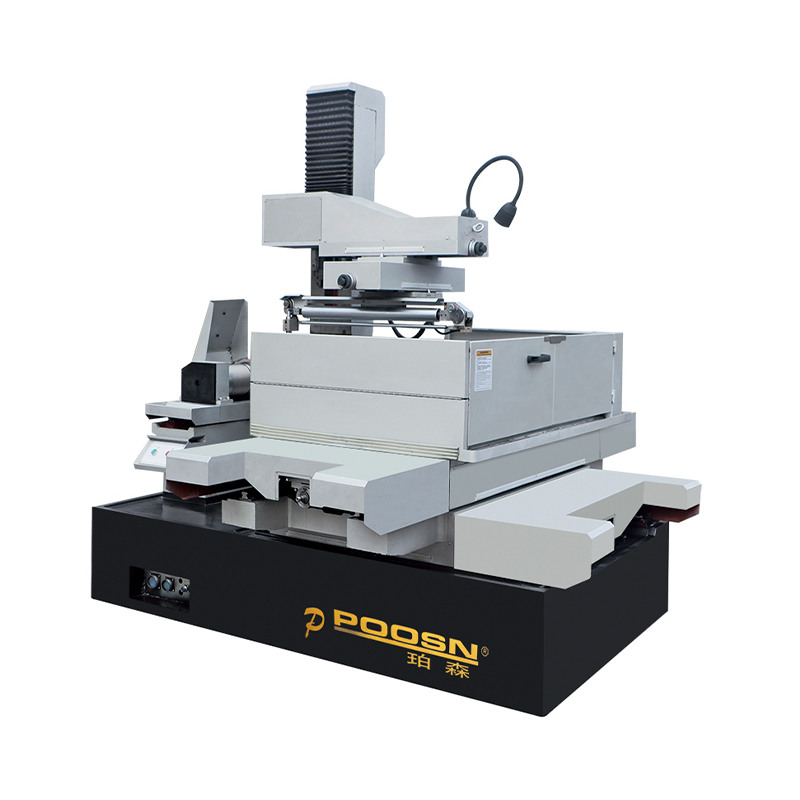
DK45D CNC Large Taper Wire Cut EDM Machine for Precision Mold Machining
Content
- 1 1. The Role of Large-Taper Wire-Cut EDM in Modern Manufacturing
- 2 2. DK45D Product Positioning and Main Advantages
- 3 3. Technical Configuration of the DK45D
- 4 4. How the Large-Taper Cutting Process Works
- 5 5. Mechanical Design and Stability
- 6 6. Electrical Discharge and Wire-Feed Performance
- 7 7. Accuracy, Surface Quality, and Production Efficiency
- 8 8. Control System and Operator Experience
- 9 9. Competitive Advantages Over Conventional WEDM Equipment
- 10 10. Manufacturing Strengths and Production Process
- 10.1 10.1 Experience in electrical discharge machining
- 10.2 10.2 Product development and technical capability
- 10.3 10.3 Factory manufacturing and inspection resources
- 10.4 10.4 Stress management and structural precision
- 10.5 10.5 Guide and tapering-device alignment
- 10.6 10.6 Electrical and control-system integration
- 10.7 10.7 Full-process quality control
- 11 11. Quality Assurance and Delivery Reliability
- 12 12. Industrial Applications
- 13 13. Production Efficiency and Cost Control
- 14 14. Customization and Configuration Options
- 15 15. DK45D Compared with Larger Models
- 16 16. Installation, Maintenance, and Long-Term Reliability
- 17 17. Technical Support and Customer Service
- 18 18. Recommended Evaluation Procedure Before Purchase
- 19 19. Frequently Asked Questions
- 19.1 Q1: What is the maximum taper capability of the DK45D?
- 19.2 Q2: What is the maximum workpiece thickness?
- 19.3 Q3: How heavy can the workpiece be?
- 19.4 Q4: Is the DK45D suitable for hardened steel?
- 19.5 Q5: Can the machine cut different upper and lower profiles?
- 19.6 Q6: What control system does the DK45D use?
- 19.7 Q7: What wire diameter is used?
- 19.8 Q8: What surface roughness can the DK45D achieve?
- 19.9 Q9: Can inexperienced operators use the machine?
- 19.10 Q10: What optional configurations are available?
- 19.11 Q11: How does the DK45D maintain accuracy during heavy cutting?
- 19.12 Q12: Which industries commonly use this type of machine?
- 20 20. Conclusion
- 21 References
- 22 Product: DK45D CNC Large Taper Wire Cut EDM Machine for Precision Mold Machining
1. The Role of Large-Taper Wire-Cut EDM in Modern Manufacturing
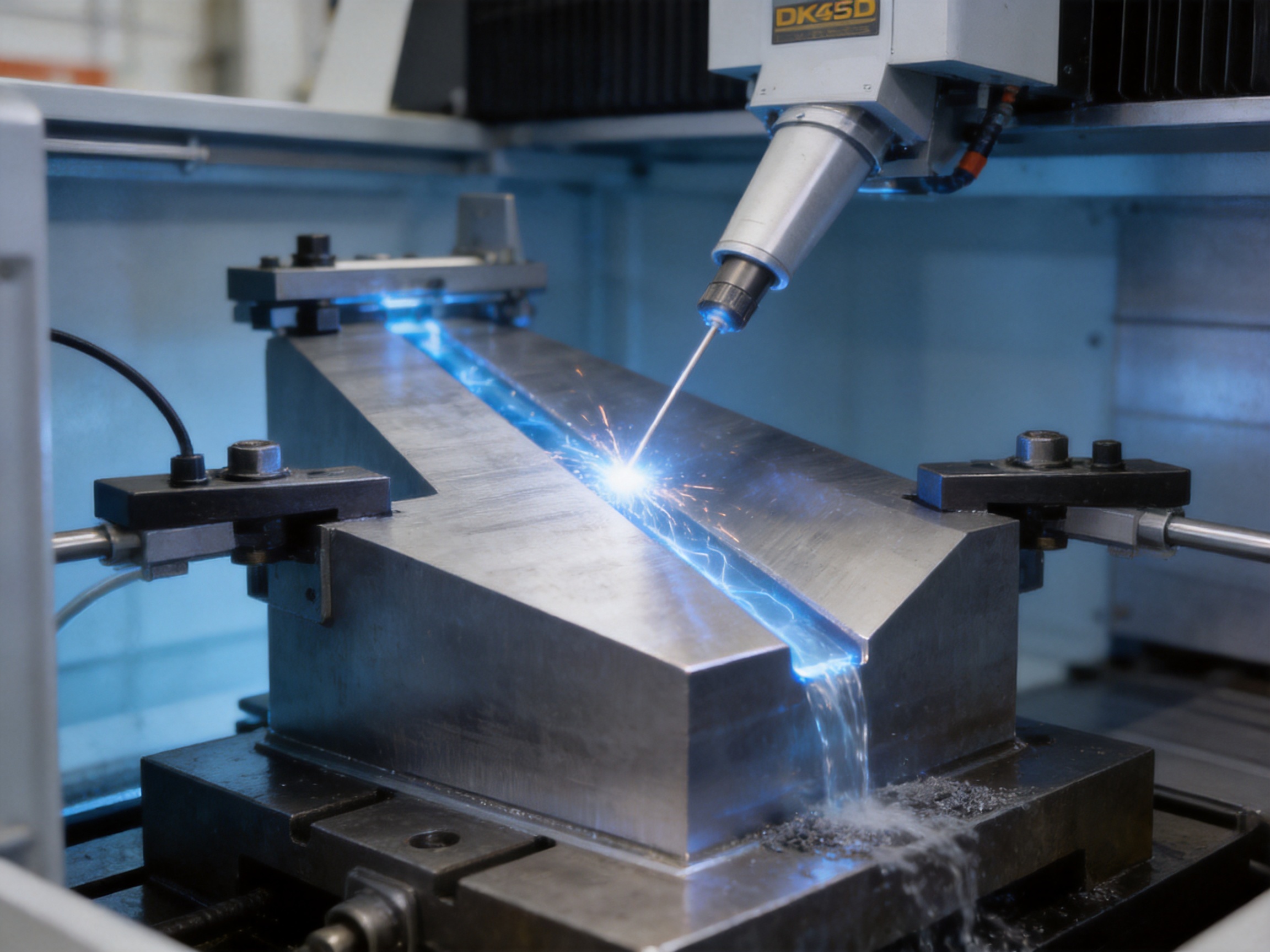
Wire-cut electrical discharge machining removes conductive material through controlled electrical discharges between a continuously moving electrode wire and the workpiece. Because the cutting process does not depend on direct mechanical contact between a conventional cutting tool and the material, WEDM is suitable for hardened steels, tool steels, carbide-related applications, alloys, and other conductive materials that may be difficult to machine through traditional milling or sawing.
Standard wire-cut EDM machines are generally optimized for vertical or relatively small-angle cutting. However, many advanced components require a wire to tilt in space while simultaneously following a programmed contour. This enables the upper and lower profiles of a workpiece to differ, allowing the machine to produce tapered openings, angled punches, inclined die sections, and complex three-dimensional geometries.
Large-taper machining creates additional technical challenges. As the wire tilts, the cutting point changes relative to the upper and lower workpiece surfaces. The effective discharge condition may vary across the thickness of the material. Wire tension, flushing direction, guide alignment, axis synchronization, and compensation calculations all become more demanding. Any weakness in the mechanical structure or control system can result in dimensional deviation, wire vibration marks, poor surface quality, or unstable cutting.
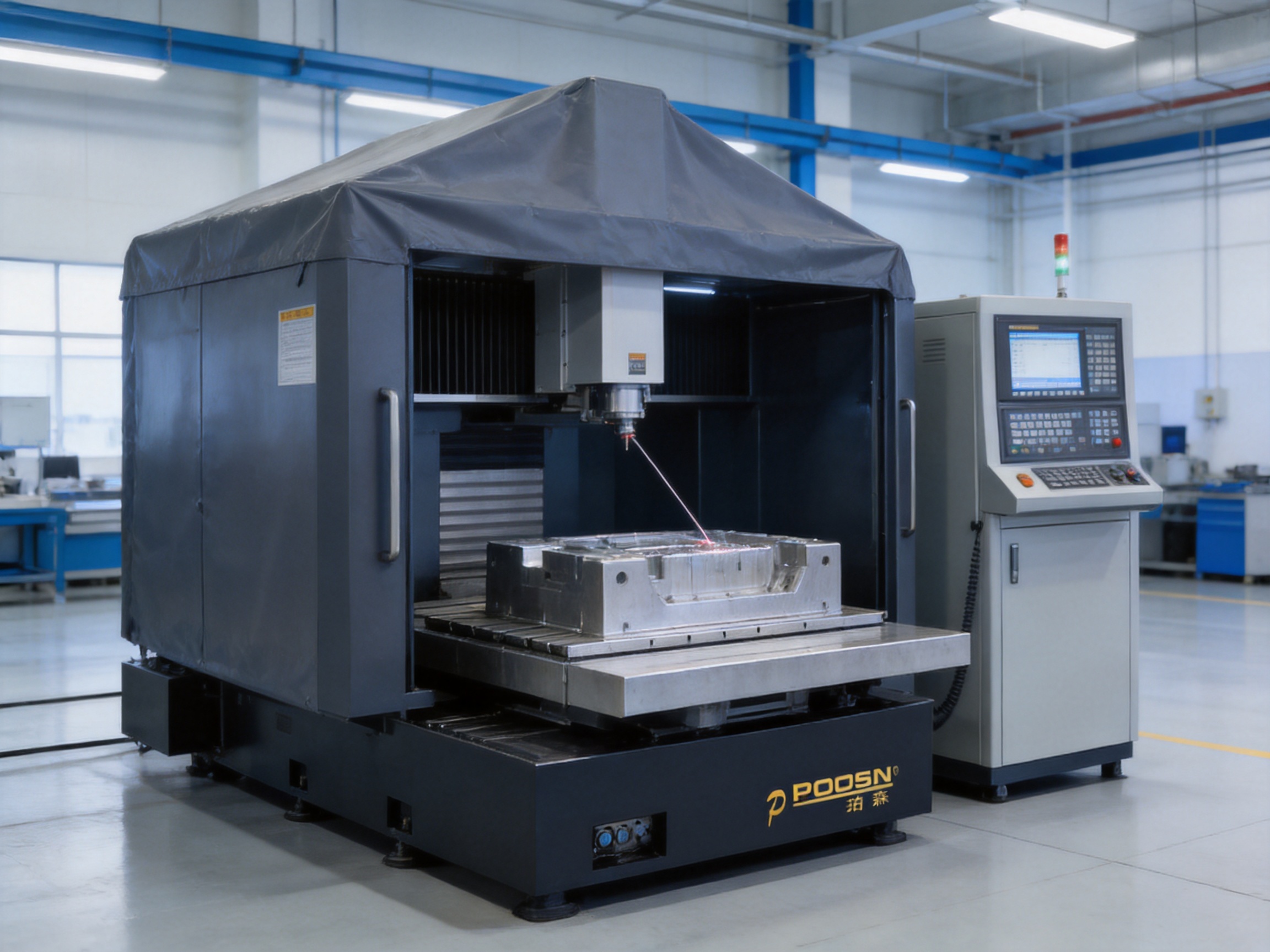
The DK45D addresses these requirements through a dedicated tapering device, four-axis linkage, high-precision linear rail support, an X8/AUTOCUT control system, and a rigid machine structure. These features allow it to operate not merely as a conventional wire-cut machine with a basic angular function, but as a platform designed for large-angle precision cutting.
2. DK45D Product Positioning and Main Advantages
The DK45D is positioned within the large-cutting-taper WEDM range. It is especially suitable for medium-sized components and precision molds that require a combination of high accuracy, large taper, and dependable production efficiency. Its working capacity makes it appropriate for companies that need more than a basic high-speed or medium-speed wire-cut machine but do not require the larger footprint and load capacity of an extra-large model.
2.1 Large-taper capability
The machine provides a maximum cutting taper of ±30° per 40 mm. This capability is significant for applications in which a vertical cut is insufficient. It supports tapered cavities, inclined punch profiles, large-angle die sections, and other geometries in which the upper and lower contours are not identical.
Compared with equipment limited to small taper angles or constant, simple tapers, the DK45D gives manufacturers greater freedom in component design. It can reduce the need for secondary machining operations and make it possible to complete complex profiles in a single controlled process.
2.2 Large cutting thickness
With a maximum cutting thickness of 450 mm, the DK45D can process relatively deep workpieces and substantial mold sections. The cutting-thickness capability is particularly useful in die manufacturing, heavy precision plates, large punches, and components where a shallow-travel machine would require additional preparation or alternative processing methods.
Cutting thickness must always be evaluated together with workpiece material, flushing conditions, wire selection, geometry, and the required surface finish. Nevertheless, the 450 mm specification provides a broad operating range for a machine of this class.
2.3 Load capacity for medium-sized heavy workpieces
The maximum worktable load is 400 kg. This allows the DK45D to handle many medium-sized molds, plates, dies, and heavy mechanical components. The load rating provides flexibility for production departments that process dense tool steels or thick workpieces without moving immediately to a much larger machine.
For workpieces beyond this range, the DK55D, DK63D, or DK80D models may be more appropriate. Correct model selection protects accuracy, reduces mechanical stress, and ensures that the machine is used within its intended operating envelope.
2.4 Four-axis simultaneous control
The DK45D uses X, Y, U, and V four-axis linkage. The X and Y axes control the primary worktable movement, while the U and V axes control the tapering motion of the wire guides. Coordinated movement allows the wire to follow complex spatial trajectories rather than being restricted to a simple planar path.
Four-axis linkage is especially valuable when the programmed upper and lower profiles differ. The control system must coordinate the motion of all relevant axes so that the wire remains on the intended cutting path. This is one of the main technical differences between a basic wire-cut machine and equipment designed for advanced taper work.
2.5 Precision and surface-finish potential
The DK45D is specified with machining accuracy according to GB/T7926-2015, a maximum cutting efficiency of 10,000 to 16,000 mm²/h, and an optimal surface roughness of Ra≤2.5 μm. Actual results depend on workpiece material, thickness, geometry, wire condition, electrical parameters, flushing, and finishing strategy. Even so, the specifications indicate that the machine is designed to balance productivity with precision rather than focusing on cutting speed alone.
2.6 User-oriented CNC operation
The X8/AUTOCUT control system provides an integrated programming and operating environment. A user-friendly interface can reduce manual intervention, simplify the setup sequence, and help operators manage complex cutting tasks. For large-taper machining, the control system is particularly important because it must translate geometric information into coordinated axis movement and compensation actions.
The machine is also suitable for organizations that have operators with limited experience in advanced taper cutting. Structured training and an intuitive interface can shorten the learning curve, while more experienced technicians can use the system for demanding production work.
3. Technical Configuration of the DK45D
The following table summarizes the principal DK45D specifications provided for the DK-D large-cutting-taper WEDM series. Some parameters are shared across the series, while others identify the DK45D specifically.
| Category | Parameter | DK45D Specification |
| CNC worktable | Worktable size | 570 × 950 mm |
| CNC worktable | X/Y travel size | 450 × 650 mm |
| CNC worktable | Processing slot size | 630 × 990 mm |
| Cutting capacity | Maximum cutting thickness | 450 mm |
| Workpiece support | Maximum worktable load | 400 kg |
| Tapering device | U/V travel size | 290 × 290 mm |
| Tapering device | Maximum cutting taper | ±30° per 40 mm |
| Wire system | Electrode wire diameter | Φ0.18 mm with wire guider |
| Wire system | Wire feed speed | 1–11 m/s, frequency control |
| Wire system | Maximum wire storage length | Approximately 350 m |
| Performance | Maximum cutting efficiency | 10,000–16,000 mm²/h |
| Performance | Optimal surface roughness | Ra≤2.5 μm |
| Axes | Controlled axes | X, Y, U, V four-axis linkage |
| Drive control | CNC worktable | Standard XY stepper drives; optional XY AC servo drives |
| Drive control | CNC tapering device | U/V three-phase stepper drives |
| Electrical system | Programming system | X8/AUTOCUT control system |
| Electrical system | Maximum processing current | 6 A |
| Electrical system | Electrical capacity | 2.5 KVA |
| Power | Power supply | 3N 380 V ±10% |
| Machine structure | Standard configuration | High-precision linear rail support and eco-friendly waterproof cover |
| Options | Available options | High-pressure water tank and linear scale |
| Dimensions | Machine size | Approximately 1,780 × 1,500 × 1,700 mm |
| Weight | Machine weight | Approximately 1,600 kg |
The table demonstrates the DK45D’s balance between working capacity and installation practicality. It offers substantial cutting thickness and taper range while remaining more compact and lighter than the larger DK55D, DK63D, and DK80D models. This balance makes it suitable for medium-sized manufacturing facilities, mold workshops, precision component suppliers, and production departments that require high capability without the space requirements of an extra-large machine.
4. How the Large-Taper Cutting Process Works
4.1 Spatial movement of the electrode wire
In a standard vertical cut, the electrode wire remains approximately perpendicular to the worktable. In a tapering operation, the wire guides move relative to one another so that the wire assumes an inclined position. The U and V axes create this offset, while the X and Y axes guide the primary contour.
When all four axes move in coordination, the DK45D can produce a workpiece whose upper contour, lower contour, or both vary according to the programmed geometry. The result may be a simple taper, a continuously changing taper, or a more complex spatial profile.
4.2 Compensation for geometric displacement
Tilting the wire changes the relationship between the programmed path and the actual discharge position. The wire has a finite diameter, and its position through the workpiece is affected by angle, thickness, tension, and guide geometry. If these factors are not compensated, the finished part may show dimensional errors between its upper and lower surfaces.
The DK45D’s control strategy is intended to manage these effects through coordinated movement and geometric compensation. By applying appropriate corrections to the X, Y, U, and V axes, the system helps the wire follow the required spatial path. This is essential for molds and components that depend on accurate taper angles, controlled clearances, and consistent profiles.
4.3 Discharge control during changing thickness conditions
Large-taper cutting can cause the effective cutting condition to change along the wire path. The discharge gap, debris concentration, flushing behavior, and thermal load may differ at different points of the workpiece. A stable EDM process therefore requires a power supply and control system that can maintain usable discharge conditions while avoiding excessive heat concentration.
The DK45D is designed to support controlled pulse energy and stable electrical discharge operation. Correct parameter selection helps reduce the risk of corner damage, local overburning, wire breakage, and inconsistent surface quality. The machine’s performance is further influenced by the operator’s choice of cutting speed, pulse conditions, wire tension, water quality, and flushing pressure.
4.4 Flushing and debris removal
EDM debris must be removed from the cutting gap to maintain a stable discharge. If particles accumulate, they can cause short circuits, unstable sparks, wire deflection, poor surface finish, or reduced cutting efficiency. In a thick or large-angle workpiece, debris removal can be more difficult because the fluid path is not uniform along the cut.
The alignment of wire guides and flushing nozzles is therefore important. The DK45D is configured with a precision wire-guiding system and an eco-friendly waterproof cover, while optional high-pressure water-tank equipment can be selected when the application requires enhanced flushing performance. These features help manufacturers adapt the machine to different material thicknesses and cutting conditions.
5. Mechanical Design and Stability
5.1 Rigid machine-bed support
Large-taper cutting places additional lateral forces and dynamic requirements on a WEDM system. The wire is inclined, the guide assemblies operate through extended positions, and the machine may process thick, heavy workpieces. A rigid bed helps limit vibration and preserves the geometric relationship between the worktable, guide system, and workpiece.
The DK45D uses a robust casting-based structure intended to provide stable support. The manufacturing approach includes attention to casting quality, stress management, machining accuracy, and assembly alignment. A stable foundation is particularly important during long cutting cycles, when even small mechanical deviations can accumulate into visible dimensional errors.
5.2 High-precision linear guides
Linear guides influence positioning smoothness, repeatability, friction behavior, and long-term motion stability. High-precision linear rail support helps the worktable and tapering mechanism move with controlled resistance. Smooth movement reduces the likelihood of vibration marks and supports more consistent interpolation during complex contours.
For manufacturers, guide quality also affects maintenance. Properly protected and lubricated guideways can retain performance for a longer period, provided that the machine is installed correctly and maintained according to its operating conditions.
5.3 Structural response during heavy loading
A workpiece weighing hundreds of kilograms changes the mechanical loading of the worktable and bed. The machine must maintain sufficient stiffness while the table moves and the wire follows a contour. The DK45D’s 400 kg load capacity is intended for medium-sized heavy components, while larger models in the same series provide higher load ratings for larger workpieces.
Using the DK45D within its rated load range helps preserve accuracy and reduces unnecessary stress on the worktable, guideways, drive system, and supporting structure. Application review before purchase is recommended for workpieces with unusual weight distribution, high centers of gravity, or complex fixture arrangements.
5.4 Protection and operating environment
The standard eco-friendly waterproof cover helps protect the machine structure and surrounding area during dielectric circulation and cutting. Effective enclosure design contributes to workplace cleanliness, reduces exposure of mechanical components to splashing fluid, and supports more organized maintenance.
Because EDM performance is sensitive to electrical supply, water condition, temperature, and cleanliness, the installation environment should be prepared carefully. A level foundation, appropriate drainage, stable power, adequate ventilation, and sufficient working space are important for reliable operation.
6. Electrical Discharge and Wire-Feed Performance
6.1 Electrode wire configuration
The DK45D uses a Φ0.18 mm electrode wire with a wire guider. This wire diameter is a practical configuration for precision cutting and general mold applications. Wire selection should be matched to the material, cutting thickness, required accuracy, surface-finish target, and production strategy.
A thinner wire may be advantageous for particularly fine details, while a larger or application-specific wire can be selected when greater cutting stability or productivity is required. The machine’s wire path and guide system must be maintained carefully because contamination, wear, or misalignment can influence accuracy and surface quality.
6.2 Variable wire-feed speed
The wire-feed speed range is 1 to 11 m/s with frequency control. Variable feed provides flexibility for different cutting conditions. Higher feed settings may support production efficiency when the discharge condition is stable, while lower or adjusted settings can be useful for precision work, difficult materials, or finishing passes.
The approximately 350 m wire-storage length supports extended unattended or semi-unattended cutting cycles, depending on the workpiece and operating parameters. Consistent wire transport is essential because irregular movement can affect the discharge gap and create variations in the machined surface.
6.3 Processing current and electrical capacity
The maximum processing current is specified as 6 A, with an electrical capacity of 2.5 KVA. The electrical system is designed to support controlled EDM cutting rather than uncontrolled high-energy discharge. In practice, the operator selects parameters according to the material and production requirement, balancing speed, dimensional precision, heat input, and surface finish.
Stable power delivery is particularly important during thick-section and large-taper operations. Abrupt electrical fluctuations can lead to unstable sparks or wire breakage. The recommended three-phase 380 V ±10% power supply should be provided through a properly installed industrial electrical system that meets local safety requirements.
7. Accuracy, Surface Quality, and Production Efficiency
7.1 Accuracy for precision molds
Precision molds often require accurate profiles, controlled clearances, smooth cutting surfaces, and repeatable results across multiple cavities or inserts. The DK45D’s large-taper function is valuable when a mold contains angled walls or a profile that changes through its thickness.
The stated machining accuracy of 0.08 mm in the product information reflects the machine’s intended accuracy class. Actual part accuracy should be verified under the specific conditions of the application. Material behavior, workpiece stress, fixturing, thermal conditions, programming quality, wire condition, and finishing operations all influence the final result.
7.2 Surface roughness
An optimal surface roughness of Ra≤2.5 μm is specified for the machine. Surface quality in wire EDM is affected by the number of finishing passes, electrical parameters, workpiece material, flushing, wire condition, and the geometry of the cut. A roughing pass prioritizes material removal, while finishing passes use lower-energy conditions to improve surface integrity and dimensional control.
For mold applications, the resulting surface may reduce the amount of manual polishing or secondary finishing required. This can be especially valuable for complex tapered surfaces that are difficult to polish consistently by hand.
7.3 Cutting efficiency
The maximum cutting efficiency is listed as 10,000 to 16,000 mm²/h. Productivity depends on the cutting area, thickness, material, taper angle, programmed path, flushing conditions, and desired finish. High production efficiency should not be considered separately from accuracy. A well-balanced process minimizes rework, secondary operations, downtime, and operator intervention.
The DK45D supports efficiency in several ways: it can process complex taper profiles in one controlled setup, it offers a long wire-storage length, it uses frequency-controlled wire feed, and it is equipped with an integrated CNC control system. These features can help shorten the overall production cycle when compared with a process that combines conventional cutting, additional fixture changes, manual correction, and secondary grinding.
8. Control System and Operator Experience
8.1 X8/AUTOCUT programming environment
The X8/AUTOCUT control system is the standard programming system for the DK45D. A suitable WEDM control system must manage coordinate data, cutting conditions, wire compensation, taper geometry, axis linkage, and operational monitoring. It should also allow operators to verify the cutting sequence and make adjustments without unnecessary complexity.
For large-taper work, the control system’s ability to coordinate the U and V axes with X and Y is essential. The operator needs to define or import the relevant geometry and specify the relationship between the upper and lower profiles. The system then calculates the coordinated movement required to guide the wire along the programmed spatial path.
8.2 Reduced manual intervention
Intelligent control features help reduce reliance on manual calculations and repeated setup corrections. This can improve consistency between operators and reduce the risk of programming mistakes. It also allows technicians to concentrate on workpiece preparation, process verification, and quality inspection rather than manually controlling every stage of the cut.
8.3 Training and practical operation
The DK45D is suitable for operators who have basic wire-cutting experience and want to develop large-taper machining skills. A structured training program should cover machine startup, wire threading, workpiece alignment, coordinate setting, programming, taper calculation, flushing, parameter selection, alarm handling, and daily maintenance.
Although an intuitive interface reduces the learning curve, operators must still understand EDM fundamentals. They should know how workpiece material, thickness, wire tension, water quality, discharge energy, and cutting speed affect the process. Proper training is one of the most effective ways to protect machine performance and reduce wire breakage or surface-quality problems.
9. Competitive Advantages Over Conventional WEDM Equipment
9.1 Broader geometric capability
Many conventional WEDM machines are designed primarily for planar profiles and limited taper angles. The DK45D expands the range of possible workpiece geometries through its dedicated tapering device and four-axis linkage. This is a major advantage for manufacturers that produce parts with inclined surfaces, changing profiles, or upper and lower contours that are not identical.
9.2 Higher suitability for large-angle cutting
A machine designed specifically for large taper can offer better process compatibility than a standard machine with a nominal taper function added as a secondary feature. The DK45D’s U/V travel, wire-guiding arrangement, mechanical structure, and control logic are aligned with the requirements of large-angle machining.
9.3 Reduced secondary processing
When a tapered profile can be cut directly, the manufacturer may reduce the need for manual grinding, re-fixturing, or additional machining. This can save production time and improve consistency. It is particularly useful in complex stamping dies, where the cutting edge and inclined surface must be accurately related to the rest of the mold.
9.4 Strong balance between size and capacity
The DK45D occupies a practical position between smaller general-purpose machines and larger heavy-duty systems. Its 450 mm cutting thickness and 400 kg load capacity provide substantial capability, while its approximately 1,600 kg weight and compact dimensions make it easier to accommodate than the larger models in the series.
9.5 Configurable drive options
The standard XY stepper drives provide a practical configuration for general operation, while optional XY AC servo drives can be selected for applications that require enhanced motion performance. Optional linear scales may also be considered when the production environment requires additional feedback and position-monitoring capability.
9.6 Application flexibility
The DK45D can process conductive materials across different hardness levels, including various steels, alloys, and metals. This gives manufacturers flexibility when production includes multiple material types. The machine is not restricted to a single mold category; it can support precision machinery, aerospace-related components, automotive parts, and specialized industrial products.
10. Manufacturing Strengths and Production Process
10.1 Experience in electrical discharge machining
The manufacturer has specialized in electrical discharge wire cutting since 1999. Long-term concentration on EDM provides an important foundation for product development because wire-cut machines require combined expertise in mechanical engineering, electrical discharge technology, CNC control, precision assembly, fluid management, and application support.
Experience also helps a manufacturer understand the practical problems encountered by end users. These include wire breakage, flushing limitations, accuracy drift, difficult taper programming, workpiece deformation, maintenance requirements, and the need to balance cutting speed with surface quality.
10.2 Product development and technical capability
The company maintains product lines covering medium-speed wire-cut EDM, high-speed wire-cut EDM, large-taper WEDM, and related special-processing equipment. This product breadth allows the manufacturer to compare different machine architectures and select appropriate solutions for different workpiece sizes, materials, and production volumes.
Its technical capabilities include product research and development, precision component processing, machine assembly, electrical integration, control-system configuration, and positioning-accuracy testing. These capabilities support continuous improvement in structure, motion control, wire transport, and operator usability.
10.3 Factory manufacturing and inspection resources
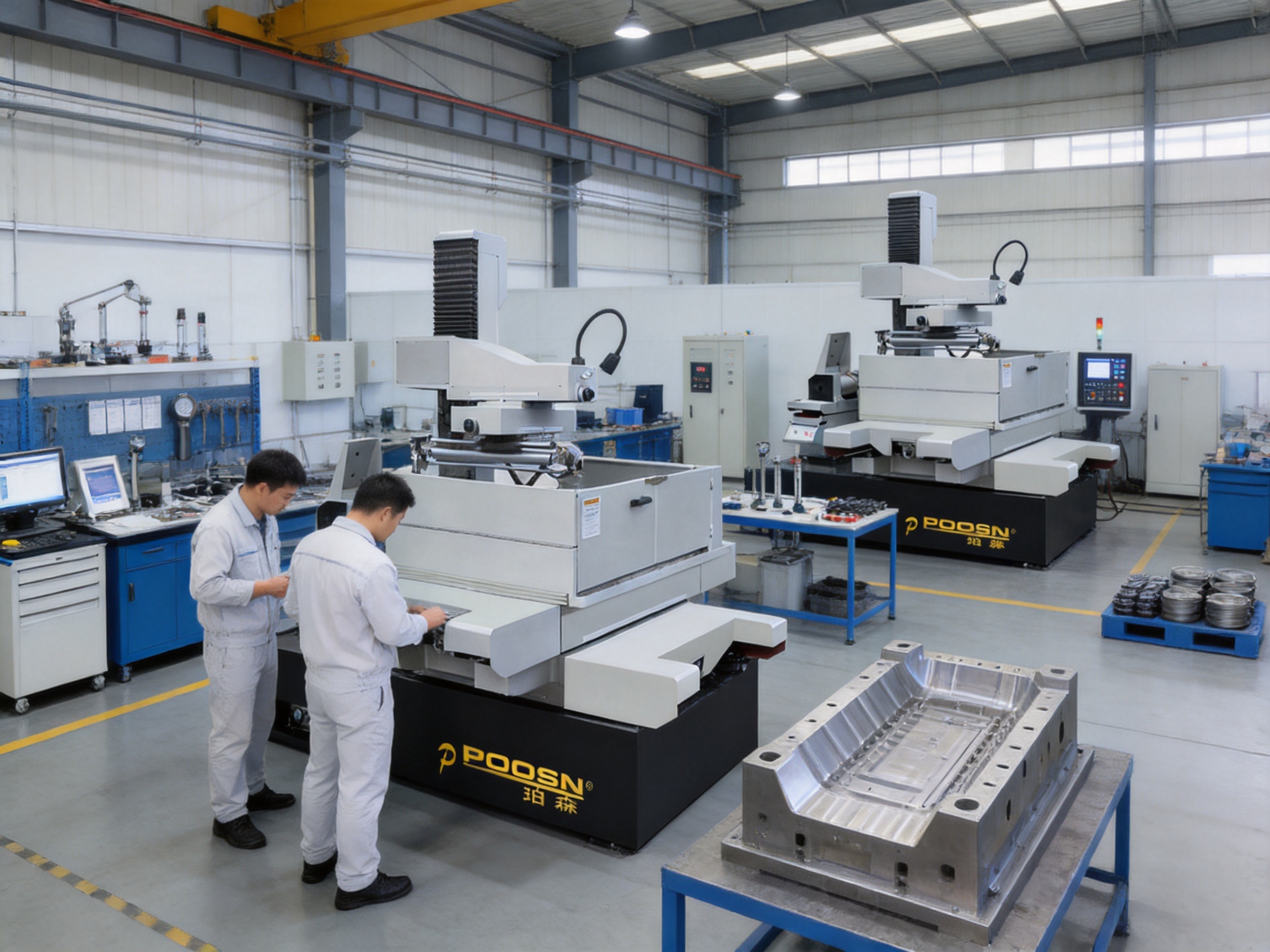
The company operates its own manufacturing facility and uses advanced processing equipment and comprehensive testing methods. Manufacturing a precision WEDM machine requires more than assembling purchased components. The bed, worktable, guide supports, tapering mechanism, wire system, electrical cabinet, and control system must be integrated accurately.
Key production stages include casting and stress management, rough and finish machining, guideway installation, worktable assembly, tapering-device alignment, electrical wiring, control-system installation, wire-path adjustment, dielectric-system testing, and final geometric verification. Each stage can influence the final performance of the machine.
10.4 Stress management and structural precision
Machine castings must be produced with attention to material quality and dimensional stability. Natural aging or other appropriate stress-relief procedures can reduce the effect of internal casting stress. After stress management, precision machining establishes the reference surfaces and mounting positions needed for guideways, worktables, and other assemblies.
This process is particularly important for large-taper WEDM because the machine structure experiences combined loads from heavy workpieces, table movement, guide offset, wire tension, and dielectric circulation. A stable structure provides a more reliable basis for calibration and long-term operation.
10.5 Guide and tapering-device alignment
Alignment between the wire guides, upper and lower guide assemblies, flushing components, and worktable is a critical manufacturing step. Inaccurate alignment can affect the effective taper angle, wire stability, and geometric relationship between the upper and lower profiles.
The tapering device must move smoothly through its working range, and the U/V axes must respond predictably to control commands. Assembly technicians therefore need to check mechanical clearances, guide positioning, axis travel, drive response, and synchronized movement before the machine is released.
10.6 Electrical and control-system integration
The electrical cabinet, discharge power supply, drive system, control interface, sensors, wire-feed system, and safety circuits must operate as one integrated platform. Electrical assembly should be organized to support reliable troubleshooting, heat management, service access, and protection against moisture and contamination.
After installation, the control system should be tested through axis movement, coordinate verification, program execution, alarm response, wire-feed operation, and electrical-discharge simulation. These tests help identify problems before shipment and support smoother commissioning at the customer’s facility.
10.7 Full-process quality control
The manufacturer emphasizes in-process self-inspection and final inspection. Quality control begins during component production and continues through assembly, calibration, operational testing, and delivery preparation. This approach is more comprehensive than relying only on a final visual check or limited sampling inspection.
Finished machines are tested against recognized accuracy requirements, and simulated machining trials can be arranged according to customer application scenarios. Full-load operational testing, precision calibration, and verification of key parameters help confirm that the machine is ready for practical production.
11. Quality Assurance and Delivery Reliability
Precision equipment must perform consistently after installation, not only during factory acceptance. The manufacturer therefore places importance on metrological verification, positioning-accuracy testing, machine operation tests, and customer-specific trial machining.
Precision calibration may include checking axis travel, positioning accuracy, repeatability, squareness, tapering movement, wire-guide alignment, and the relationship between programmed and actual movement. The exact inspection process depends on the machine configuration and applicable standards.
Operational testing is equally important. A machine may meet geometric requirements when stationary but still show instability during extended cutting. Full-load and continuous-operation tests can reveal issues involving heat, drive behavior, wire transport, dielectric circulation, electrical discharge, and control-system response.
Customer-specific simulated machining is valuable because different industries prioritize different performance characteristics. A mold manufacturer may focus on taper accuracy and surface finish. An aerospace supplier may prioritize complex spatial profiles and repeatability. A precision machinery producer may require stable production over long operating cycles. Application-oriented testing helps connect factory inspection with real production needs.
12. Industrial Applications
12.1 Precision mold manufacturing
Precision molds are among the most important applications for the DK45D. Die and mold components often require hardened materials, narrow clearances, complex profiles, and inclined or tapered surfaces. Wire EDM can produce accurate internal openings, punches, inserts, cutting edges, and shaped cavities after heat treatment.
The DK45D is particularly useful for molds that require large taper angles. It can help reduce the need for secondary grinding and manual correction, while its four-axis movement supports differences between upper and lower profiles. This may improve the relationship between mold components and reduce assembly problems.
12.2 Large blanking and stamping dies
Large blanking dies may contain long cutting edges and tapered sections that must remain geometrically consistent. The DK45D can cut these profiles with controlled wire movement and may complete a tapered edge in one principal operation, depending on the design and process requirements.
Reducing the number of setups can lower the risk of alignment errors. It can also improve traceability because the main contour is generated within one coordinated CNC process.
12.3 Aerospace components
Aerospace parts often combine complex geometry with strict requirements for accuracy and surface integrity. Components featuring aerodynamic profiles, inclined sections, slots, and specialized openings may benefit from large-taper wire cutting.
The DK45D can support the production of selected aerospace tooling, fixtures, profiles, and conductive components. Its application should be evaluated according to the specific material, certification requirements, tolerance, and inspection protocol of the aerospace project.
12.4 Automotive components
Automotive manufacturing uses wire EDM for tooling and precision parts associated with steering, transmission, stamping, forming, and specialized mechanisms. Irregularly shaped parts may require repeatable contour cutting and reliable dimensional control.
The DK45D’s balance of working capacity, efficiency, and taper capability makes it suitable for medium-scale automotive component production and toolmaking. Optional servo drives or linear scales may be considered when the production environment requires enhanced motion feedback or repeatability.
12.5 Precision machinery and specialized gears
Precision machinery manufacturers often produce parts that cannot be cut efficiently with standard tools because of hardened materials, narrow slots, unusual contours, or complex profiles. Wire EDM offers a non-contact cutting process that can reduce mechanical cutting forces.
The DK45D can be applied to specialized gears, mechanical inserts, precision plates, and other conductive parts that require controlled contour accuracy. Large-taper capability adds value when the part design includes inclined tooth forms, tapered openings, or nonparallel surfaces.
13. Production Efficiency and Cost Control
The economic value of a wire-cut EDM machine should be measured across the entire production process. Cutting speed is only one factor. A machine that reduces setup time, rework, manual correction, secondary grinding, wire breakage, and downtime may generate greater value than equipment with a higher nominal cutting rate but limited geometric capability.
The DK45D can support cost control by allowing complex taper profiles to be machined directly. Four-axis coordination can reduce repeated repositioning, while the long wire-storage length supports extended operation. The control system can reduce manual intervention, and the machine’s ability to process thick workpieces may simplify the production route.
Stable operation also protects material utilization. When a high-value tool steel or alloy workpiece is damaged by an unstable cut, the cost includes not only the replacement material but also lost programming time, setup labor, machine capacity, and delivery schedule. Reliable structure, controlled discharge, and appropriate flushing help reduce this risk.
Manufacturers should evaluate operating cost based on wire consumption, electricity, dielectric maintenance, filters, labor, maintenance, finishing requirements, and expected machine utilization. A process trial using the customer’s material and geometry is the best way to establish realistic production economics.
14. Customization and Configuration Options
Customization is available for selected application requirements. Worktable dimensions, cutting-angle requirements, drive configuration, feedback systems, and auxiliary equipment can be discussed according to the workpiece and production environment.
The standard configuration includes high-precision linear rail support and an eco-friendly waterproof cover. Optional equipment includes a high-pressure water tank and linear scale. XY AC servo drives are also available as an alternative to standard XY stepper drives.
Customization should be based on a complete technical review rather than a single specification. Important information includes workpiece dimensions, material, hardness, thickness, weight, required taper angle, upper and lower contour relationship, tolerance, surface finish, production quantity, expected cutting time, and factory power conditions.
For unusually large or heavy applications, the DK55D, DK63D, or DK80D may be more appropriate. These models provide larger worktable dimensions, greater travel, higher load capacity, and increased cutting thickness. Choosing the correct model at the beginning is more effective than attempting to operate a medium-sized machine beyond its intended capacity.
15. DK45D Compared with Larger Models
The DK45D is intended for medium-sized components and precision molds. Its 450 mm maximum cutting thickness and 400 kg worktable load make it a practical choice for many mold and component applications.
The DK55D increases the worktable size to approximately 740 × 1,160 mm, provides 550 × 800 mm of X/Y travel, supports up to 600 kg, and offers a maximum cutting thickness of 600 mm. It is better suited to larger workpieces and more demanding load conditions.
The DK63D provides approximately 844 × 1,360 mm of worktable area, 630 × 1,000 mm of X/Y travel, an 800 kg maximum load, and 600 mm maximum cutting thickness. It is appropriate for larger aerospace parts, heavy mold components, and substantial precision workpieces.
The DK80D is the largest listed model, with approximately 1,020 × 1,620 mm of worktable area, 800 × 1,200 mm of X/Y travel, an 1,000 kg maximum load, and 800 mm maximum cutting thickness. It is intended for extra-large workpieces, heavy-duty molds, and high-difficulty production tasks. Customizable options are available for the DK80D and larger machines according to project requirements.
| Model | Typical application position | Maximum cutting thickness | Maximum worktable load |
| DK45D | Medium-sized components and precision molds | 450 mm | 400 kg |
| DK55D | Large workpieces and complex components | 600 mm | 600 kg |
| DK63D | Extra-large workpieces and heavy components | 600 mm | 800 kg |
| DK80D | Heavy-duty molds and very large workpieces | 800 mm | 1,000 kg |
This comparison shows that the DK45D is not simply a smaller version of the larger machines. It is a targeted solution for manufacturers whose workpieces fit its travel and load range but still demand serious large-taper capability.
16. Installation, Maintenance, and Long-Term Reliability
Proper installation is essential to achieving the DK45D’s rated performance. The machine should be placed on a suitable foundation, leveled accurately, connected to a stable electrical supply, and provided with appropriate dielectric-water management. The surrounding area should have sufficient space for workpiece loading, maintenance access, wire handling, and operator movement.
Daily maintenance should include checking wire condition, guides, rollers, flushing nozzles, dielectric-water cleanliness, filters, worktable surfaces, and abnormal noise or vibration. Operators should remove conductive debris and prevent contamination from accumulating around critical components.
Regular maintenance should include guide inspection, lubrication, drive-system checks, electrical-cabinet cleaning, water-system service, sensor verification, and accuracy checks. The maintenance interval should reflect machine utilization, workpiece material, operating environment, and cutting intensity.
Wire guides and contact components are consumable or wear-sensitive parts. Their condition directly affects wire stability and cutting accuracy. Replacing worn components before they cause visible quality problems can reduce scrap and protect the machine’s overall performance.
Water quality also deserves attention. Conductivity, filtration, temperature, and contamination influence EDM stability. A properly maintained dielectric system supports consistent discharge, reduces short circuits, and helps maintain surface quality over extended production runs.
17. Technical Support and Customer Service
Professional technical support is important because WEDM performance depends on correct programming, parameter selection, setup, and maintenance. The manufacturer provides rapid-response technical support intended to help customers maintain equipment stability and long-term effectiveness.
Support may include model selection, application review, installation guidance, operator training, process consultation, troubleshooting, maintenance recommendations, and spare-parts assistance. Before purchasing, customers should discuss the specific application in detail so that the machine, optional equipment, wire configuration, and control functions match the production requirement.
Operator training should not be limited to basic startup and shutdown. It should also explain how to prepare the workpiece, establish references, verify the taper direction, confirm upper and lower contours, select cutting parameters, monitor the discharge, respond to alarms, and evaluate the finished surface.
For international customers, clear documentation and communication are especially important. Installation conditions, power requirements, water systems, foundation specifications, safety procedures, and recommended maintenance schedules should be confirmed before shipment.
18. Recommended Evaluation Procedure Before Purchase
A technical evaluation should begin with the customer’s largest and most difficult representative workpiece. The workpiece should be reviewed for dimensions, material, thickness, hardness, weight, taper angle, profile complexity, tolerance, and surface-finish requirements.
The next step is to compare the workpiece against the DK45D’s travel, cutting thickness, load capacity, U/V travel, and taper range. If any parameter is close to the machine limit, the customer should consider fixture size, clamping method, workpiece balance, flushing access, and clearance around the guide system.
A sample cutting trial is recommended for critical applications. The trial can verify actual cutting time, taper accuracy, surface finish, dimensional consistency, wire consumption, and the required number of finishing passes. It can also determine whether optional equipment such as a high-pressure water tank, linear scale, or AC servo drive is beneficial.
The customer should also evaluate the complete ownership process. This includes delivery time, installation, training, spare parts, warranty conditions, remote support, maintenance capability, and availability of technical documentation. A reliable supplier should be able to explain not only what the machine can do, but also how it will be integrated into the customer’s production system.
19. Frequently Asked Questions
Q1: What is the maximum taper capability of the DK45D?
The DK45D provides a maximum cutting taper of ±30° per 40 mm. This makes it suitable for large-angle taper cutting, inclined mold sections, complex contours, and workpieces whose upper and lower profiles differ.
Q2: What is the maximum workpiece thickness?
The maximum cutting thickness is 450 mm. The actual usable thickness depends on the material, workpiece geometry, flushing conditions, wire configuration, and required cutting quality.
Q3: How heavy can the workpiece be?
The maximum worktable load is 400 kg. Workpieces should be positioned and fixtured so that the load is distributed appropriately. For heavier components, the DK55D, DK63D, or DK80D should be considered.
Q4: Is the DK45D suitable for hardened steel?
Yes. Wire EDM is suitable for conductive hardened materials, including many tool steels and alloys. Cutting parameters should be selected according to the material grade, thickness, hardness, geometry, and surface-finish requirement.
Q5: Can the machine cut different upper and lower profiles?
Yes. The X, Y, U, and V four-axis linkage enables spatial wire movement and supports applications in which the upper and lower contours are different. The programming method and workpiece geometry should be reviewed before machining.
Q6: What control system does the DK45D use?
The standard programming system is the X8/AUTOCUT control system. It is designed to provide an intuitive operating environment and coordinate the machine’s four-axis taper-cutting functions.
Q7: What wire diameter is used?
The listed electrode wire diameter is Φ0.18 mm with a wire guider. Specific wire choices may be discussed according to the application, cutting accuracy, surface-finish target, and material.
Q8: What surface roughness can the DK45D achieve?
The optimal surface roughness is specified as Ra≤2.5 μm. The final result depends on the number of passes, electrical parameters, material, thickness, flushing, wire condition, and finishing strategy.
Q9: Can inexperienced operators use the machine?
The DK45D uses an intuitive control interface and is designed to reduce manual intervention. Operators with basic wire-cutting experience can learn large-taper operation through systematic training. Proper instruction remains necessary for safe and accurate production.
Q10: What optional configurations are available?
Optional configurations include a high-pressure water tank, linear scale, and XY AC servo drives. The appropriate selection depends on the customer’s workpiece size, accuracy requirement, production intensity, and factory conditions.
Q11: How does the DK45D maintain accuracy during heavy cutting?
Accuracy is supported by the rigid machine structure, high-precision linear rails, controlled axis movement, tapering-device design, wire-guiding system, and CNC compensation functions. Actual accuracy also depends on correct installation, fixturing, parameter selection, maintenance, and environmental stability.
Q12: Which industries commonly use this type of machine?
Typical applications include precision mold manufacturing, stamping and blanking dies, aerospace tooling and components, automotive parts, precision machinery, specialized gears, and other conductive components with complex profiles or large taper requirements.
20. Conclusion
The DK45D CNC Large-Taper Wire-Cut EDM Machine is designed for manufacturers that require more than ordinary contour cutting. Its principal strengths are its ±30° per 40 mm taper capability, 450 mm maximum cutting thickness, 400 kg worktable load, four-axis X/Y/U/V linkage, X8/AUTOCUT control system, precision linear rail support, and flexible configuration options.
These features give the DK45D a strong position in precision mold machining and complex component production. Compared with conventional WEDM equipment limited to small tapers or simple two-dimensional profiles, it offers broader geometric capability and can reduce the need for secondary grinding, re-fixturing, and manual correction.
The machine’s value is also supported by the manufacturer’s broader strengths. Long-term experience in electrical discharge machining, in-house production, technical development, precision processing, comprehensive inspection, operational testing, and application-oriented support provide an integrated foundation for dependable machine-tool delivery.
For medium-sized molds, inclined die components, aerospace-related profiles, automotive tooling, and precision mechanical parts, the DK45D can provide a practical combination of accuracy, flexibility, cutting thickness, and production efficiency. A detailed application review and sample cutting trial should be completed for critical projects, but the machine’s configuration makes it a capable solution for demanding large-taper wire-cut EDM work.
References
1. Product technical information for the DK-D Large Cutting Taper WEDM Series, including DK45D, DK55D, DK63D, and DK80D specifications.
2. GB/T7926-2015, Accuracy of Wire-Cut Electrical Discharge Machines.
3. General principles of electrical discharge machining, wire electrode transport, dielectric flushing, and pulse-energy control.
4. Technical documentation for CNC four-axis linkage and taper compensation in wire-cut EDM systems.
5. Industrial guidelines for precision mold manufacturing and wire-cut electrical discharge machining process control.
Product: DK45D CNC Large Taper Wire Cut EDM Machine for Precision Mold Machining

-
Phone
+86-0523-86268788 +86-13815960366 +86-13912191163Email
[email protected]Address
No. 366, Yusheng Road Jiulong Town, Hailing District Taizhou City, China
Copyright © Taizhou Xinchengyang Machinery Manufacturing Co., Ltd. All Rights Reserved.
Custom edm machine for sale
wholesale edm machine manufacturers
